En thumbnials of the images

Embellishment done right! · Marcus Short, Ricahrd Pacey & Jordan Pugh · Qualvis Print & Packaging

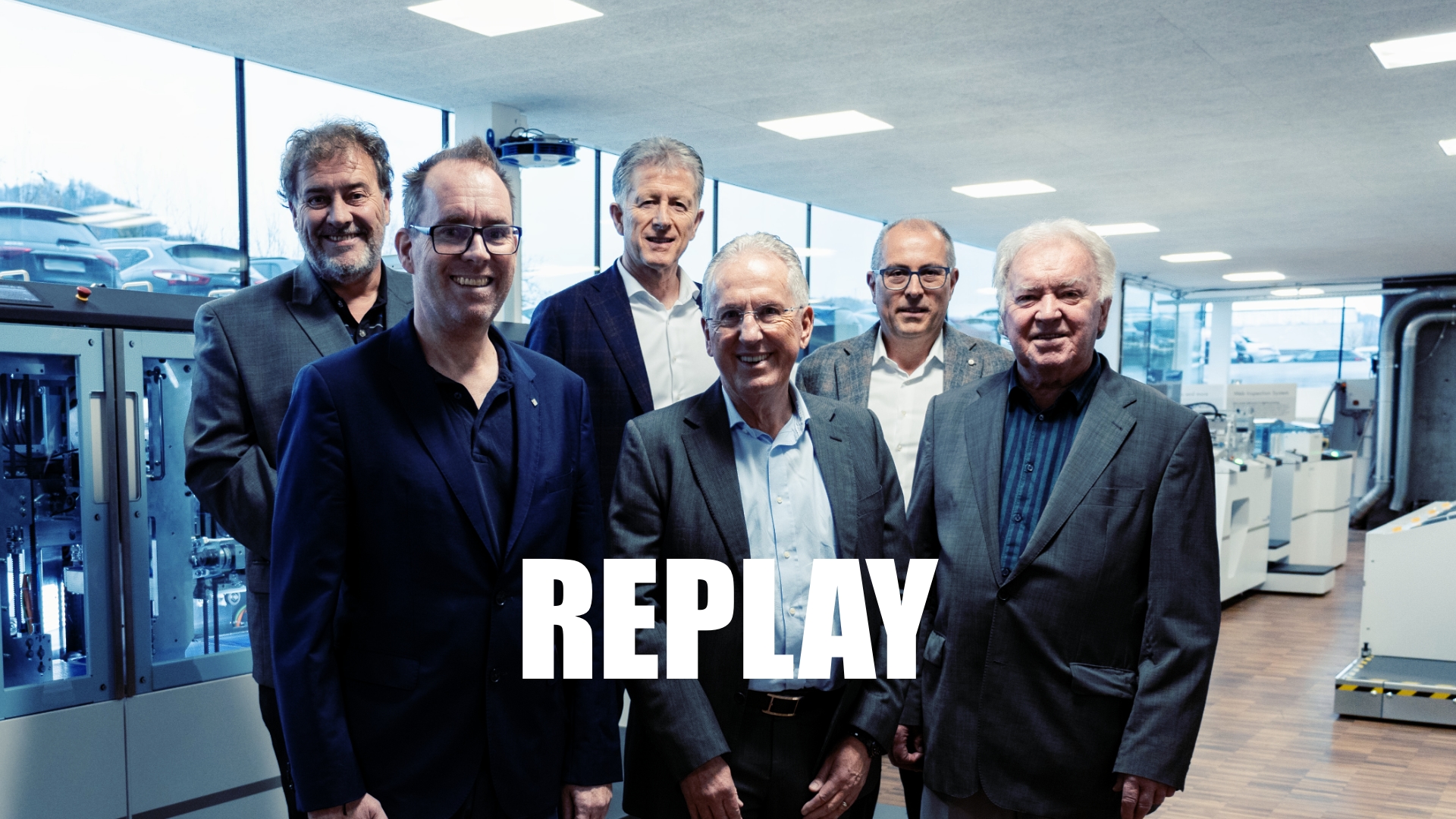
It's difficult to decide how to start this story. It's about a print and packaging company in Leicester investing in new technology. A new Koenig & Bauer press and a new folding/gluer, also from Koenig & Press. In a way, enough, but there is more to it, because the configuration of the printing press is as such unique, and as Richard Pacey explains, maybe the only one in the world. A seven-color with three coaters. But doesn't that lead to the more obvious question, why? And that's really the story. Qualvis is a print and packaging company that has specialized in high-end packaging. As we sit in the meeting room before the filming, tons of samples are placed on the table, and, of course, we look at them. Marcus Short asks us - so how do you think it's made? It looks like overprinted coldset, yet it has a different shine, and it's still the best option. And here is what Qualvis has developed over the years. Instead of using cold foil, Qualvis has developed Q-lustre. It's a flexo-printed, reflective silver color, UV-dried, and ready to be overprinted, just like a cold foil. The result is a stunning print with a metalization that actually doesn't have any metalization, as we know. It's more sustainable because it doesn't use a foil carrier, the company claims, and customers like what they see. Combined with a fast folding/gluer, the company's existing blue Koenig & Bauer Rapida press, and a few BOBST die-cutters, the company is well set for the future, and the three gentlemen we speak with are all game and ready. This was a fun job!

En thumbnials of the images

Mark Nixon · Global Strategic Account Director · AVT

In this conversation, Morten B. Reitoft from INKISH sits down with Mark Nixon to explore a career that began on the shop floor of a printing company at just fifteen years old and has since evolved into a global role within print inspection and automation at AVT. Mark shares the accidental but formative start that pulled him into print, the appeal of the smells, the pace, and the constant problem-solving, and how those early experiences shaped a lifelong connection to an industry that changes minute by minute. Together they reflect on how print differs from many other manufacturing sectors, why its technical complexity is often underestimated, and how careers in print rarely follow a straight, pre-planned path. The discussion moves into Mark’s transition from market-creating companies to a business focused on efficiency, repeatability, and waste reduction, and how inspection systems have shifted from being seen as a necessary evil to becoming a core part of lean, profitable production. They talk openly about quality control, customer expectations, and the idea that it is better to prevent problems from reaching the customer in the first place than to argue about them afterward. Mark explains how modern inspection goes far beyond finding faults, integrating deeply with workflow automation to identify, remove, and replace errors before delivery. The conversation also looks ahead, touching on where inspection technology is heading, the growing importance of speed, intelligence, and customization, and the role of close collaboration with customers and other technology providers. Mark reflects on joining an independent, established company that now operates with a startup mindset, the opportunities that come with it, and how decades of experience across different print technologies can be brought together to drive the next phase of innovation. It’s an honest, wide-ranging discussion about print, technology, business, and the value of staying curious in an industry that never stands still.

En thumbnials of the images

Building a Packaging Powerhouse Through People, Process, and Technology with Koenig & Bauer

Paul Densley, Managing Director of Castle Color, shares his journey from the newspaper print industry to leading one of the UK’s most respected and technically advanced packaging companies. In this film, Paul talks openly about Castle Color’s philosophy of people, process, and technology, and how that mindset has shaped everything from investment decisions to customer relationships. He explains why Castle Color focuses on being an embedded supply partner, how continuous training and process understanding sit at the core of the business, and how technology is used to enhance people rather than replace them. The conversation goes deep into Castle Color’s expertise in fiber-based packaging, including cartons, advanced barrier coatings, and highly specialized blister card technologies that are guaranteed to seal. Paul outlines the company’s diverse customer base across food, healthcare, hygiene, personal care, and sporting goods, and explains why the type of packaging matters more than the size of the customer. Paul also reflects on Castle Color’s disciplined approach to machinery investment, including rigorous testing, supplier comparisons, and the long-term impact of choosing the right technology partner. He shares real-world experience of consolidating production onto fewer presses while increasing productivity, retaining and retraining staff, and building strong, long-term relationships with suppliers. Looking ahead, Paul discusses the future of fiber-based packaging, sustainability, and how Castle Color plans to continue pushing the boundaries of packaging technology and design over the next decade.

En thumbnials of the images

Is AI a useful tool or a threat to a brand? · Gee Ranasinha · CEO · Kexino

Happy New Year, and welcome to INKISH’s first interview of 2026. Morten Reitoft is joined by his good friend Gee Ranasinha for a wide-ranging conversation about AI, with a particular focus on generative AI and what it really means for marketing, creativity, branding, and trust. They unpack the difference between machine learning, generative AI, and agentic AI, discuss why tools alone don’t replace human judgment, and explore how brands risk becoming generic if technology is used without intent. The discussion moves from AI in marketing and design to bigger questions about authenticity, differentiation, security, and the future value of human creativity in an AI-driven world. I asked ChatGPT if it believes that Generative AI can be a threat to brands - and here is its answer: Yes — generative AI can be a threat to a brand, but only under certain conditions. Generative AI becomes a threat when it is used as a shortcut rather than a tool. If a brand relies on AI to produce content without clear direction, taste, or accountability, the result often drifts toward generic, formulaic output. Over time, this can erode distinctiveness, making the brand harder to recognize and easier to replace. When everything starts to look and sound “AI-made,” audiences subconsciously read it as inauthentic, low-effort, or interchangeable. The real risk is not the technology itself, but the loss of human judgment. Brands are built on consistency, intent, and emotional resonance — things that require someone to decide why something should exist, not just how it can be produced. If AI is allowed to define tone, visuals, or messaging without strong brand governance, the brand can slowly hollow out, becoming a polished shell that says nothing meaningful. Used correctly, however, generative AI is not a threat at all. It can accelerate ideation, lower production friction, and help teams explore more options in less time. When guided by clear brand principles, human taste, and strategic oversight, AI can strengthen a brand rather than weaken it. In that sense, AI raises the floor of execution — but it does not raise the ceiling. Brands that continue to stand out will be the ones that use AI to move faster, not the ones that let AI decide who they are. In short: generative AI threatens brands that surrender authorship to it. Brands that treat it as an assistant, not a substitute, will be just fine.

En thumbnials of the images

Trevor Schroeder · Director of Product & Solutions · PageWide T700i · HP

This video features Trevor Schroeder discussing how HP approaches print as a set of distinct segments, shaped by long experience in areas such as photo printing, publishing, direct mail, and commercial print, and more recently by rapid growth in packaging. He reflects on the industry’s shift from analog to digital and how similar transformations are now playing out across all segments, with inkjet packaging standing out because of its speed, quality, and ability to handle very high volumes. Labels and packaging are described as a significant growth opportunity within HP’s portfolio, combining inkjet and liquid electrophotography technologies.

The conversation explains how packaging differs from other print segments due to supply chain complexity, large repeat volumes, and increasingly unreliable forecasts. Digital printing, supported by more interconnected software and ERP systems, enables faster responses to changing demand. Schroeder also addresses material and substrate challenges, including long or unpredictable lead times and strong demand driven by the shift from plastic to paper, particularly in Europe. These trends require manufacturers to reassess strategies, understand their customers’ needs, and invest in the right equipment.

The video also touches on material science collaboration across the value chain, ongoing consolidation in the packaging industry, and the importance of manufacturing efficiency beyond the press itself. Digital production is presented as a way to optimize entire plant workflows, free up constrained capacity, and unlock growth within existing assets. The discussion concludes with insights into HP PageWide Industrial’s focus on high-throughput, integrated systems and platform-based investments designed to adapt to evolving packaging and corrugated market demands.

En thumbnials of the images

Even Lucanish · Product Marketing & Business Development · PageWide T700i · HP

This video features Even Lucanish explaining how digital packaging solutions are designed to complement, not replace, large-scale analog production. He emphasizes that the packaging industry still depends on long runs, which is why significant effort has gone into ensuring that the economic crossover points between digital and litho production make practical sense. The discussion focuses on how digital presses can add capacity, modernize older equipment setups, and improve overall efficiency within packaging facilities.

Lucanish describes the T700 as a strong fit for the litho-lamination market, particularly for integrated producers or larger independents with single-face laminators. The press is positioned as a complementary asset that allows shorter runs to be shifted to digital, while longer runs remain on litho equipment, reducing setup times and improving utilization across the plant. He explains how higher laminator speeds, enabled by roll-fed digital printing, can increase throughput and unlock additional capacity in existing operations.

The video explores the concept of crossover economics, noting that jobs under roughly 30,000 sheets are often more cost-effective digitally, especially when multiple SKUs are involved. Digital printing allows multiple graphics to be produced sequentially in a single continuous run, effectively combining many short runs into a single longer digital run. Beyond cost, color consistency is highlighted as a key advantage, with digital production delivering repeatable results over time without manual adjustments.

Lucanish also addresses broader adoption challenges, explaining that packaging has been more cautious with digital than commercial print, but that real-world installations have helped demonstrate its benefits. He points to easier staffing and training, tighter integration with MIS and ERP systems, and long-term platform upgradability as essential factors. The video concludes with a comparison of the T700 and T1100 platforms, outlining how form factor, corrugator compatibility, and versatility determine where each solution fits within the packaging and corrugated markets.

En thumbnials of the images

Chris Pereira · President · C17 Media

This video follows the development of a print operation in Toronto that evolved from print brokering into complete in-house manufacturing over more than a decade. What began with basic commercial print needs gradually expanded into wide-format production, vehicle graphics, and specialized automotive and motorsport applications. The conversation explains why depending on external vendors became a limitation—particularly around scheduling, consistency, and accountability—and how bringing production in-house changed both operational control and long-term planning. Growth happened incrementally, through measured investments in equipment, space, and people rather than rapid expansion. A significant part of the discussion focuses on workflow and automation. As job volumes increased and margins tightened, software became critical to meeting timelines and controlling costs. The video outlines how imposition is handled using Ultimate Tech software, where layouts are automatically generated based on material type, sheet or roll size, flute direction for corrugated work, and production method. This reduces manual intervention, material waste, and ink usage, while improving repeatability across jobs. Ultimate Tech is shown as one component in a broader workflow that also includes web-to-print, ERP, preflighting, and accounting systems. Rather than being implemented all at once, the workflow was built piece by piece, with adjustments made over time as requirements became clearer. The video also addresses early limitations, the evaluation of alternative solutions, and why the final setup reflects practical production needs rather than theoretical efficiency.

En thumbnials of the images

Felix Fischer · Managing Director · Die Pharmadrucker

German edition click here. A small, family-owned printing company in Germany focuses entirely on pharmaceutical and cosmetics printing, with a strong ambition to be the fastest producer of pharmaceutical leaflets and instructions for use. The business originated from a concession to print a weekly newspaper, which served as the foundation for the Bernecker family’s printing activities. For decades, print news remained dominant, but over the past 20 years, the industry has changed significantly. Despite the company’s heritage and long-term direction, recent global instability has shown that outside forces can quickly disrupt small businesses. The pharmaceutical focus began roughly ten years ago, though they had handled related work earlier. Over time, customer needs and available production technologies pushed them further into the pharma niche. Finding skilled labor in Western Europe is difficult due to demographic change and fewer young people pursuing manufacturing roles. The company attracts younger workers with its flat structure, but must invest in training. Pharmaceutical print remains highly specialized even though it still involves printing, cutting, and folding. The substrates used are extremely light—40 to 60 gsm—and require technical adjustments, new processes, and training to manage. Their promise of fast delivery — often within 24 hours and typically within 10–15 working days — sets them apart. Their small size and short-run focus make this speed possible. To support this model, they are transitioning from offset to inkjet, eliminating plates, chemicals, and various mechanical components. This shift improves turnaround time, maintenance needs, and sustainability. The company’s folding work is highly complex—often involving more than ten folds—and few machine builders can support these requirements. H+H became a partner because both companies shared the same development goals. Their configuration includes rotary cutting followed by complex folding. The M9 folder automates pocket adjustment, appealing to younger employees who expect touchscreen functionality. Operators still fine-tune settings, but setup time is drastically reduced. The company sees itself as a development partner, helping refine both folding and thin-paper inkjet solutions. Implementations required collaboration, careful communication, and rapid response to issues from the technology supplier. The production setup delivers major benefits: faster operation, fewer processing steps, fewer operators, reduced error potential, and greater value creation in a single line. The move to inkjet also eliminates heat as a production factor, which they note as significant.

De thumbnials of the images

Felix Fischer · Geschäftsführer · Die Pharmadrucker

Ein kleines, familiengeführtes Druckunternehmen in Deutschland konzentriert sich vollständig auf den Pharma- und Kosmetikdruck und verfolgt das klare Ziel, der schnellste Produzent von Beipackzetteln und Gebrauchsanweisungen zu sein. Das Unternehmen entstand aus einer Konzession zum Druck einer lokalen Wochenzeitung, die den Grundstein für die Druckaktivitäten der Familie Bernecker legte. Über Jahrzehnte hinweg blieb der Zeitungsdruck führend, doch in den vergangenen zwanzig Jahren hat sich die Branche stark verändert. Trotz des Erbes und der langfristigen Ausrichtung hat die jüngste globale Instabilität gezeigt, dass äußere Einflüsse kleine Unternehmen schnell beeinträchtigen können. Die Spezialisierung auf Pharmazie begann vor etwa zehn Jahren, obwohl entsprechende Arbeiten bereits zuvor durchgeführt wurden. Mit der Zeit führten Kundenanforderungen und die verfügbaren Produktionstechnologien zu einer stärkeren Ausrichtung auf dieses Marktsegment. Es ist schwierig, in Westeuropa qualifizierte Arbeitskräfte zu finden – bedingt durch demografische Entwicklungen und die abnehmende Zahl junger Menschen, die eine Tätigkeit im produzierenden Gewerbe wählen. Das Unternehmen zieht junge Mitarbeiter durch flache Hierarchien an, muss jedoch in deren Ausbildung investieren. Pharma-Druck bleibt trotz seiner Ähnlichkeit mit herkömmlichem Drucken, Schneiden und Falzen hochspezialisiert. Verarbeitet werden extrem leichte Grammaturen – 40 bis 60 g/m² –, die eine technische Anpassung, neue Prozesse und Schulungen erfordern. Das Versprechen schneller Lieferungen, häufig innerhalb von 24 Stunden und typischerweise innerhalb von 10–15 Arbeitstagen, hebt das Unternehmen deutlich hervor. Seine geringe Größe und der Fokus auf Kleinauflagen ermöglichen diese Geschwindigkeit. Zur Unterstützung dieses Modells stellt das Unternehmen von Offset- auf Inkjetdruck um und eliminiert damit Druckplatten, Chemikalien sowie verschiedene mechanische Prozessschritte. Diese Umstellung verbessert die Durchlaufzeiten, den Wartungsaufwand und die Nachhaltigkeit. Die Falzarbeiten sind hochkomplex – oft mit mehr als zehn Falzungen – und nur wenige Maschinenhersteller können diese Anforderungen erfüllen. H+H wurde Partner, weil beide Unternehmen die gleichen Entwicklungsziele verfolgen. Die Konfiguration umfasst einen rotativen Querschneider, gefolgt von einer komplexen Falzmaschine. Die M9-Falzmaschine automatisiert die Einstellung der Taschen, was insbesondere für jüngere Mitarbeitende attraktiv ist, die eine Touchscreen-Bedienung erwarten. Die Bediener müssen weiterhin Feinjustierungen vornehmen, doch die Rüstzeiten werden erheblich verkürzt. Das Unternehmen versteht sich als Entwicklungspartner und trägt zur Optimierung sowohl der Falz- als auch der Dünndruck-Inkjet-Lösungen bei. Die Implementierung erforderte enge Zusammenarbeit, präzise Kommunikation und schnelle Reaktionszeiten seitens des Technologieanbieters. Der Produktionsaufbau bietet erhebliche Vorteile: höhere Geschwindigkeit, weniger Prozessschritte, weniger Bedienpersonal, geringeres Fehlerrisiko und höhere Wertschöpfung in einer einzigen Linie. Der Umstieg auf Inkjet eliminiert zudem Hitze als Produktionsfaktor, was als bedeutend hervorzuheben ist.

En Es-MX De-DE thumbnials of the images

Precision Finishing Powering Growth: How Grupo Gama Delivers World-Class Packaging

Language: Spanish - Subtitles: Spanish, English & German. Miguel Ángel Mondragón de la Garza has led finishing at Grupo Gama for more than 15 years, transforming printed work into high-quality packaging, brochures, books, corrugated and folding cartons—all produced entirely in-house. The family business began 30 years ago, when his brother Carlos started with small equipment and gradually built toward today’s advanced operation. Miguel joined after working in metallurgy in Monterrey, helping develop the workshop from its earliest days. The finishing department handles continuous changeovers, ensuring fast, high-quality output while keeping costs low. Preventive maintenance, process control, and minimizing repair time are essential to staying competitive. Modernization is constant. The team upgrades machines to improve speed, accuracy, and material handling, gradually retiring older systems. Miguel highlights his experience learning on early Brausse equipment and emphasizing how European machines—especially Koenig & Bauer—have helped solve critical corrugation and alignment challenges. Over years of testing and collaboration, Koenig & Bauer solutions proved reliable, and today the plant runs four Koenig & Bauer systems among roughly 24 machines. Key innovations include the Ipress and the Omega Allpro 130 gluers, which deliver precise, perfectly aligned boxes and reduce production headaches. Miguel takes pride in seeing finished packaging on display and continues to push innovation to help the company meet customer demands and stay competitive in a changing market.   Made in collaboration with Revista el Impresor