






















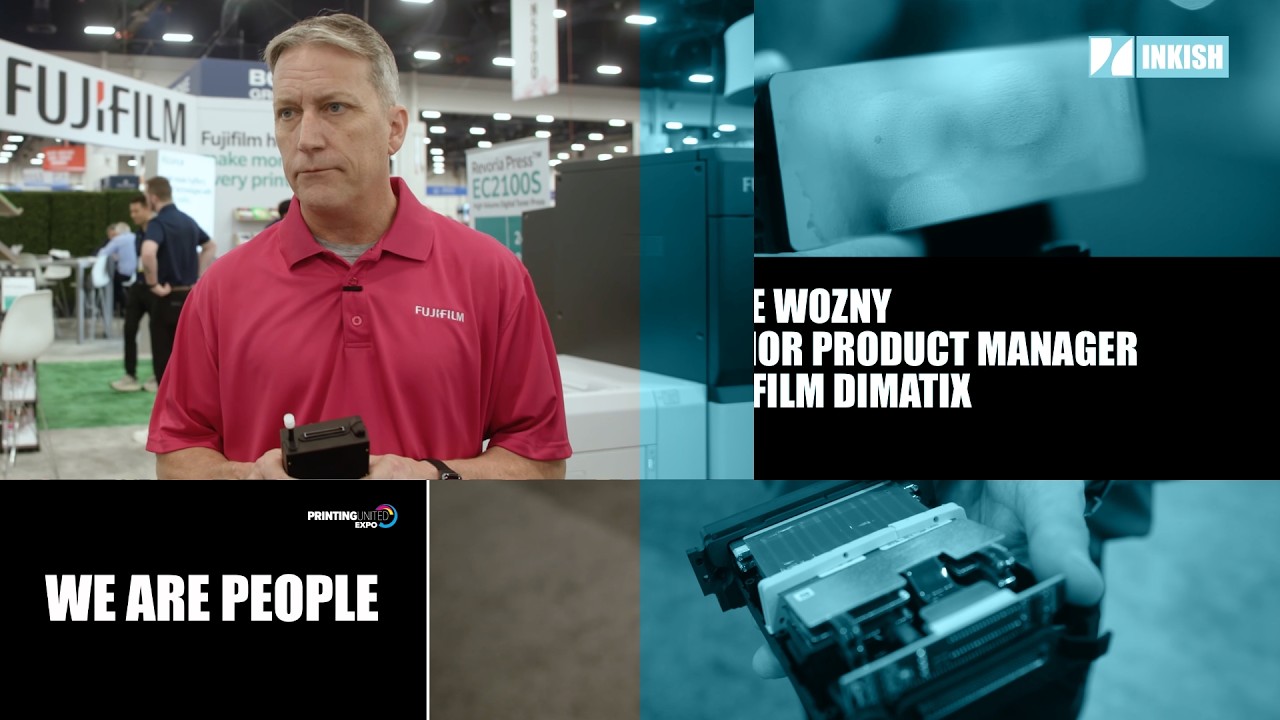
Mike Wozny · Senior Product Manager · Fujifilm Dimatix
Most people in the graphic arts industry know Fujifilm for presses, plates, inks and production printing, but underneath many industrial inkjet applications is another part of Fujifilm that most print buyers rarely see: FUJIFILM Dimatix.
At PRINTING United in Las Vegas, Morten B. Reitoft meets Mike from FUJIFILM Dimatix to see the worldwide debut of the new STARFIRE PhaseMaster 1024 printhead — and quickly discovers that this isn’t simply another printhead for another graphic arts printer.
The PhaseMaster combines technologies and experience from two long-established Dimatix platforms, Galaxy and STARFIRE, but introduces something particularly interesting: the ability to jet hot-melt fluids at temperatures up to 125°C.
And that opens applications far beyond what most of us traditionally think of as printing.
Direct-to-screen production, coding and packaging, printed electronics, photovoltaic manufacturing and additive manufacturing are among the applications discussed in the interview. Even jewelry enters the conversation, where inkjet can be part of highly detailed additive processes used to create customized designs.
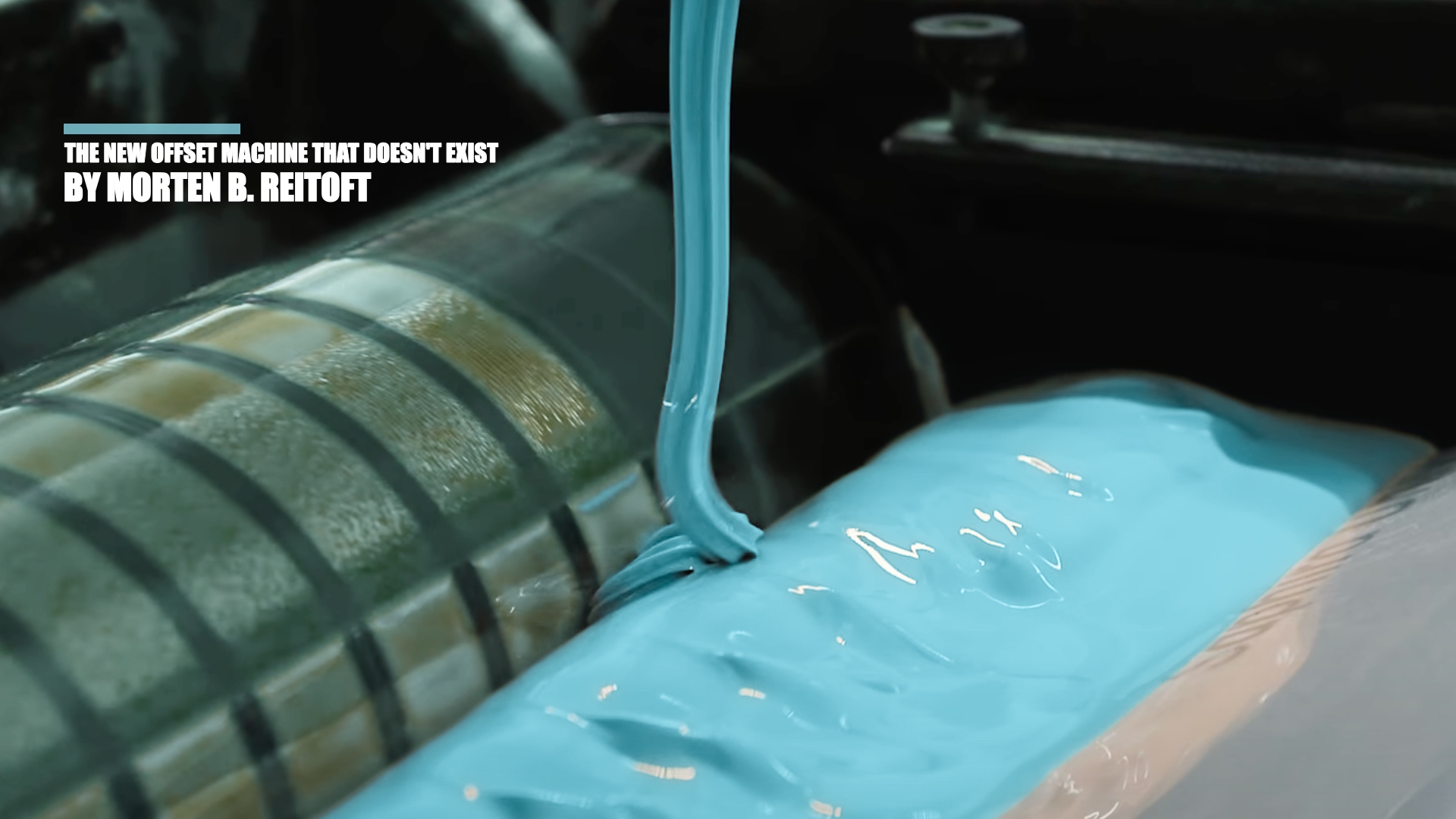
One particularly relevant application for the graphic arts industry is direct-to-screen. Rather than producing screens through conventional imaging processes, an industrial system equipped with PhaseMaster heads can jet material directly onto the screen. With the ability to lay down significant amounts of fluid at production speed, inkjet becomes part of the manufacturing process rather than simply a technology for putting an image onto paper.
This distinction is important.
FUJIFILM Dimatix doesn’t necessarily build the final machines that users will eventually operate. Instead, it develops the printhead technology that OEMs, integrators and equipment manufacturers use as the foundation for entirely new production systems.
The engineering behind PhaseMaster is equally interesting. Operating fluids at temperatures as high as 125°C creates an obvious challenge: the fluid needs heat, but electronics generally don’t. Dimatix therefore separates the thermal environments inside the head, using cool, dry air to keep the electronics at considerably lower temperatures while maintaining the required temperature in the jetting area.
The PhaseMaster has 1,024 individually addressable nozzles and can be configured with multiple heads across a printbar, allowing equipment manufacturers to build systems in different widths. Individual heads print one color, but multiple heads can also be configured to create multi-color systems.
For Morten, the conversation becomes an interesting reminder of how broad inkjet technology has become. What began as a way of putting ink onto substrates is increasingly becoming a precision deposition technology capable of placing controlled amounts of fluid exactly where manufacturers need it.
And that means the future market for inkjet may be considerably larger than the printing industry itself.
Watch the conversation from PRINTING United in Las Vegas and get a closer look at the new FUJIFILM Dimatix STARFIRE PhaseMaster — and some of the industrial applications that could be built around it.



No Data Found.
Content for this section will appear here once available
Thu September 24th
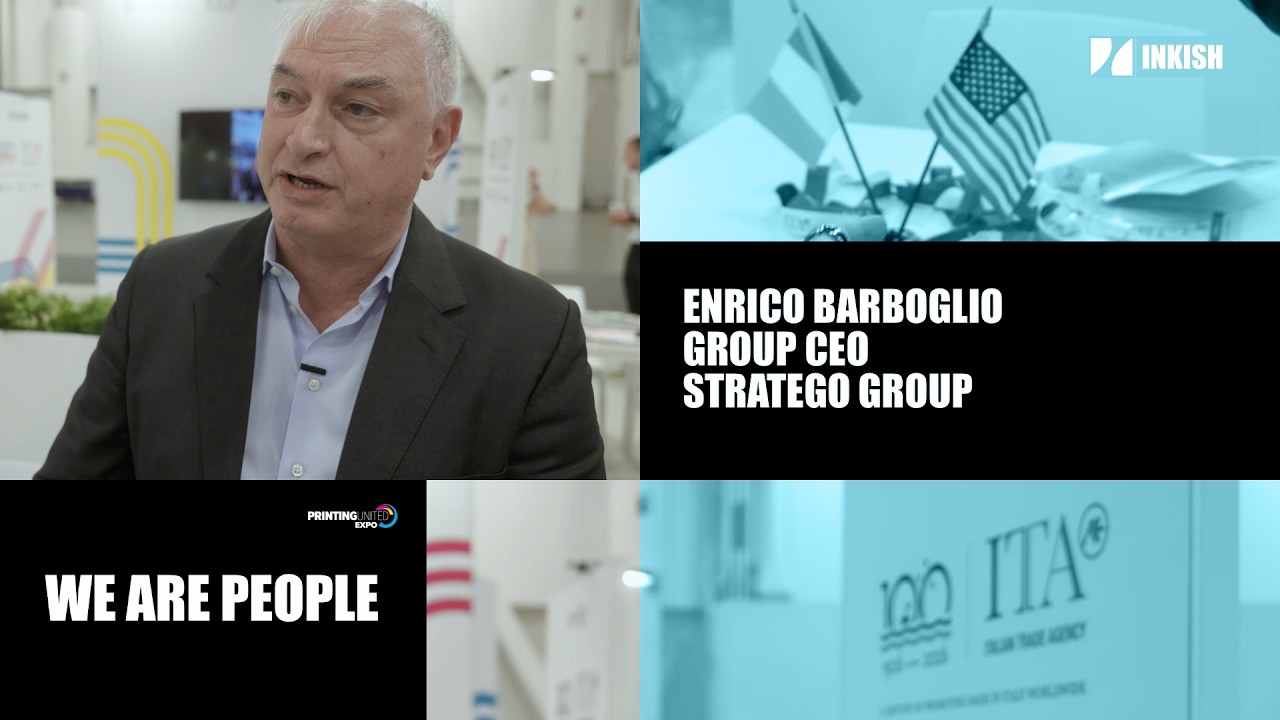
Enrico Barboglio · Group CEO · Stratego Gr...
Italy has a long and important history in printing and converting technology, but technology alone isn't enough to build an international market. You also need connections. At PRINTING United 2026 in Las Vegas, Pat McGrew meets longtime industry friend Enrico Barboglio at the Italian Trade Agency pavilion to talk about why Italian companies are exhibiting in the United States — and why an international trade show is about considerably more than selling machines. The Italian Trade Agency, together with the Italian printing and converting industry, has brought a group of companies to Las Vegas representing different parts of the production ecosystem. There are machinery manufacturers, software developers, color and process-control specialists, personalization technology and companies providing knowledge and communication to the graphic arts industry. It is only a small representation of the Italian printing industry. Many more Italian manufacturers are exhibiting elsewhere at PRINTING United through American subsidiaries, distributors and partners, illustrating just how significant Italian technology has become across printing, packaging, converting and finishing. For Enrico, however, the most important reason for being in Las Vegas can be summed up in one word: connection. Companies come to PRINTING United to meet customers and potential partners, of course, but they also come to learn. They meet other manufacturers, discover technologies, understand how markets are developing and create relationships that can ultimately lead to entirely new business opportunities. And those relationships work in both directions. Italian companies can introduce American printers and converters to technologies they may not already know, while conversations with the North American market provide Italian manufacturers with new ideas, requirements and perspectives to bring home. PRINTING United is therefore one stop on a much longer international journey. That journey leads toward Print4All in Milan in 2027. Print4All was created to bring together technologies and applications from across printing and converting rather than treating individual print segments as isolated industries. Commercial printing, digital, offset, flexo, gravure, converting, packaging, finishing and increasingly software and automation are all becoming part of a much more connected production ecosystem. That thinking is now being developed further through closer cooperation between ACIMGA and ARGI and the creation of the Printing & Converting Technology Alliance. The objective is to represent technology across the complete printing and converting value chain and create a stronger platform for manufacturers, suppliers, printers, converters, brands and international markets to meet. And perhaps that reflects the industry itself. A printing company rarely buys technology in isolation anymore. Presses need software. Software needs data. Printing requires finishing. Packaging requires converting. Automation requires communication between systems. And increasingly, the companies building those technologies need each other just as much as their customers need them. The machinery may be what visitors initially come to see. But relationships are what ultimately move an industry forward. Watch Pat McGrew's conversation with Enrico Barboglio at the Italian Trade Agency pavilion at PRINTING United 2026 in Las Vegas — and hear why international connections are such an important part of the future of Italian printing and converting technology.