





















Christoph Gamper 路聽CEO 路 DURST Group 路聽FESPA Barcelona 2026

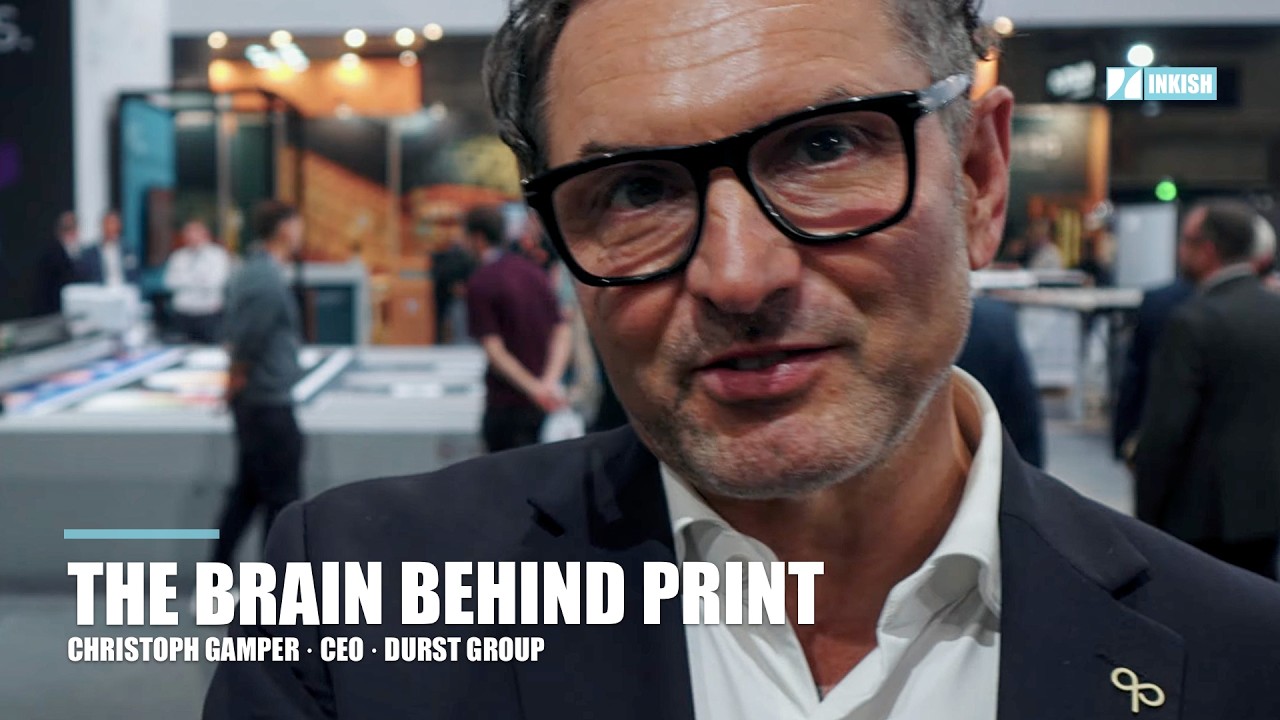
At FESPA in Barcelona, Editor-in-Chief Morten Reitoft once again speaks with Christoph Gamper from Durst Group about Kyveris, one of the industry鈥檚 most ambitious visions for automation, intelligence, and the future of production.

What started as an idea has now evolved into a working sandbox environment where the first concepts behind Kyveris are becoming real. But as Christoph Gamper explains, Kyveris is not 鈥渏ust a robot鈥 connected to a machine. The robot is only one small part of a much larger vision built around industrial intelligence, connected workflows, physical AI, and systems that continuously learn from every print produced.

The conversation explores how future production environments may optimize themselves through substrate behavior, ink interaction, motion control, and data-driven learning, all moving toward increasingly autonomous and eventually lights-out manufacturing.

A fascinating teaser conversation ahead of more announcements expected at the upcoming Durst Technology Festival, where Durst plans to reveal even more about what Kyveris may become in the future.

En The future is ALSO what we make it to be 路聽Christoph Gamper 路聽CEO 路聽DURST Group

The future is ALSO what we make it to be 路聽Christoph Gamper 路聽CEO 路聽DURST Group

What happens when AI, autonomous systems, and print production begin to merge? In this deep and highly philosophical conversation, Editor Morten B. Reitoft from INKISH speaks with Christoph Gamper from DURST about the future of print, automation, software, and human interaction with technology. Recorded at Expogr谩fica in Guadalajara, the interview moves far beyond machinery and production equipment into questions about how value will be created in the future, how AI agents may negotiate production automatically, and why the next generation of print manufacturing could become increasingly autonomous. Christoph Gamper explains why he believes print production will evolve toward 鈥渓ights-out鈥 manufacturing environments, where human roles shift from manual operation toward orchestration, architecture, and decision-making. The discussion explores labor shortages, autonomous logistics, AI-driven workflows, and why the future may depend less on closed software ecosystems and more on open, hardware-agnostic systems capable of dynamically connecting entire production environments. The conversation also introduces DURST鈥檚 vision behind 鈥淜yveris,鈥 a concept Christoph Gamper describes as a connection between human knowledge and AI-driven systems designed to create value for real people. Rather than focusing on software lock-ins or isolated ecosystems, the discussion centers on how decades of industrial knowledge can be translated into intelligent systems that help printers optimize production, improve efficiency, and rethink how print businesses operate. This is not simply a discussion about presses or automation. It is a conversation about leadership, technological optimism, the role of AI in manufacturing, and how the print industry may fundamentally change over the next decade.

En Christoph Gamper 路聽CEO 路聽DURST 路聽LabelExpo Barcelona 2025

Christoph Gamper 路聽CEO 路聽DURST 路聽LabelExpo Barcelona 2025

Morten from Inkish interviews Christoph Gamper, CEO of Durst Group, at LabelExpo in Barcelona. Despite the extreme heat in Hall 3, Christoph shares that business at Durst is just as 鈥渉ot,鈥 with the company continuing to grow and now having over 4,200 systems installed worldwide, including more than 550 digital label systems, and 33 owned companies. He explains that a collective mindset within the company drives Durst鈥檚 success鈥攚hile they don鈥檛 aim to be the biggest, they strive to be the best in technology. Everyone at Durst has bought into this goal, creating what he describes as a big, happy family pushing forward together. Christoph says he spends little time in his office and is often traveling to meet customers, attend trade shows, and visit markets like China and the United States, ensuring he stays close to the market and to customers鈥 needs. He sees his role as leading the innovation roadmap while also 鈥渟niffing the markets鈥 to deeply understand customer pain points, with Durst鈥檚 mission being to remove those pains. He credits Durst鈥檚 success to its strong mid-management, close collaboration between teams, and a culture where leadership actively engages with both staff and customers. He also outlines Durst鈥檚 expansion beyond labels into other areas, especially packaging, including corrugated and folding carton, through Durst Group鈥檚 partnership with Koenig & Bauer under Koenig & Bauer Durst. In addition, Durst remains committed to large-format printing, ceramics, 3D printing, additive manufacturing, and new ventures in software. Christoph highlights All4Labels as a customer and mentions being particularly proud of All4Site, a company he founded in New York, brought back to Europe, and which is now rapidly growing under Redstone Capital with major clients like Nike. He concludes that while not every segment develops at the same speed, Durst is growing strongly, expanding strategically, and maintaining its focus on innovation, quality, and customer satisfaction.

En Martin Leitner 路聽Director Product Management 路 Labels & Flexible 路 Durst 路聽LabelExpo Barcelona 2025

Martin Leitner 路聽Director Product Management 路 Labels & Flexible 路 Durst 路聽LabelExpo Barcelona 2025

Morten from Inkish interviews Martin from Durst at LabelExpo 2025 in Barcelona. Martin explains that Durst鈥檚 mission is to lead the label industry鈥檚 transition from conventional to digital production, constantly adding new features and technologies. He says digital inkjet printing is now fully industrial鈥攔eliable, simple to operate, and no longer in its infancy鈥攁nd that the industry鈥檚 focus is shifting toward people, automation, and software to enable more efficient production, potentially even lights-out manufacturing in the future. He notes that while hybrid presses remain important in some regions, especially in the US and parts of Europe, standalone digital presses are still the core of Durst鈥檚 business because of their flexibility, shorter web paths, and ease of operation. Martin also points to growing demand for personalization and especially variable data printing, with customers now regularly producing up to 100,000 linear meters of variable jobs per week, which requires a strong data infrastructure and automation to feed data to the press efficiently. Martin introduces Durst鈥檚 new Tau 340 G3 platform, which builds on their previous models but brings a range of improvements. It maintains 1200x1200 dpi resolution and speeds of 80鈥100 meters per minute across 340, 420, or 510 mm widths, offering more flexibility and productivity. The G3 features a redesigned operator area, new systems to protect printheads from poor-quality or wavy materials, automatic registration, new backend software, improved electronics and temperature control, and many other visible and hidden enhancements that reduce waste, speed up setup, and make operation easier. He says the G3 will succeed the Tau 340 RSCI platform while the current RCE model remains available. Martin concludes that the G3 is designed to be highly reliable, easy for operators to run, and backed by Durst鈥檚 in-house expertise in chemistry, mechanics, and software, along with knowledge drawn from other industries like graphics, textile, and ceramics鈥攎aking it a strong step forward in digitalizing the label industry.