All videos

Select the movie you want to view

Thu June 25th

En

Mark Brown · Standard Finishing · Region...

At Fujifilm's Open House in Hanover, Illinois, just outside Chicago, Morten B. Reitoft speaks with Mark Brown from Standard Finishing Systems about the important role finishing plays in creating value-added print products. Most people know Standard Finishing Systems through its long-standing partnership with Horizon and its broad portfolio of finishing solutions, but as digital printing continues to evolve, finishing becomes an increasingly important part of the conversation. From booklet makers, saddle stitchers, perfect binders, and slitter-cutter-creasers to rotary die-cutting solutions, finishing is often the final step that transforms a printed sheet into a product with real impact. The discussion explores how finishing and embellishment increasingly work hand in hand. As more printers invest in technologies that enable special colors, coatings, foils, textures, and other enhancements, finishing equipment must be capable of handling these applications without compromising quality. Mark explains how modern finishing systems are designed to work with even highly embellished products while maintaining productivity and precision. The conversation also touches on how finishing can become a gateway to new business opportunities. Whether producing uniquely shaped products, premium business cards, packaging prototypes, direct mail applications, or specialty marketing materials, finishing technologies help printers expand beyond traditional applications and create products that stand out. A particularly interesting part of the conversation is the discussion about where embellishment ends and finishing begins. From soft-touch business cards with gold foil to uniquely shaped printed products, Mark shares how finishing technologies help bring creative ideas to life and turn print into something customers want to touch, keep, and remember. As vendors continue to bring new printing technologies to market, partnerships between press manufacturers and finishing suppliers become increasingly important. Mark also shares perspectives on the integration between printing and finishing technologies and why collaboration across the industry is essential to delivering complete solutions to customers. A great conversation about finishing, embellishment, workflow integration, and why the final step in production is often where the real value is created.

Fri June 5th

En

Mark Boyt · Principal Analyst, Productio...

At Intergraf Print Matters in Budapest, Morten Reitoft speaks with Mark Boyt, Principal Analyst at Keypoint Intelligence, following his presentation on robotics and automation in the printing industry. As labor shortages, rising costs, and increasing production demands continue to challenge print service providers, robotics is emerging as one of the industry's most discussed technologies. The conversation explores the practical realities behind industrial robotics, humanoid robots, and automation on the production floor. Mark explains that while humanoid robots attract significant attention, many of the real challenges still come down to fundamental issues such as gripping, handling, and moving printed materials efficiently. Whether the future belongs to robotic arms, mobile robots, humanoids, or a combination of technologies, the goal remains the same: helping printers maintain productivity in an environment where skilled labor is becoming increasingly difficult to find. Morten and Mark also discuss one of the industry's most important questions: who ultimately benefits from productivity gains? Historically, much of the value created by automation has been passed on to customers in the form of lower prices. As robotics becomes more widespread, printers will face decisions about whether productivity improvements should strengthen profitability, offset labor shortages, or support continued price competitiveness. The discussion examines how robotics is already being implemented in print production environments, including examples of companies developing their own robotic integrations rather than relying solely on equipment manufacturers. Mark shares insights into the growing ecosystem of robot suppliers, system integrators, and print technology vendors that are shaping the next generation of automated production. Another important theme is accessibility. While robotics has traditionally been viewed as a major capital investment, new business models such as Robotics-as-a-Service could make automation available to smaller printing companies that previously lacked the resources to invest. This shift may help democratize access to automation across the industry and enable businesses of all sizes to benefit from robotic technologies. The interview concludes with a broader discussion about the future of robotics in print, the role of AI, and how industry adoption may accelerate as solutions become more standardized, affordable, and easier to deploy. A fascinating conversation about technology, productivity, workforce challenges, and the next wave of automation transforming the printing industry.

Thu June 30th

En

Mark Bale · DoDxACT @ #SeikoOpenWeek2022...

If you wonder what DoDxAct stands for you are probably not the first to ask, and understanding what Mark Bale does - the name is ingenious! The abbreviation is short for Drop On Demand (e)Xact - and that is exactly what all this is about. As you know, or will learn in this film, the printheads are only one of the essential components of a functional printer. The controller, the ink, and obviously the substrate needs to be aligned to make a perfect output. Mark Bale focuses on the printhead, where he teaches, consults, and also has a lab where he can test all of the above. Enjoy the film!  

Wed September 14th

En

Mark Andy’s Digital Transformation...

Mark Andy is an American family-owned company with strong values. It has a strong global base in the label/flexible packaging segment. As we meet Vice President Stu Gallup at LabelExpo-Americas, we not only see and learn about the digital/hybrid products on display but also learn about Mark Andy's offering of consumables as part of the delivery promise. In this film, Stu Gallup shows us the three machines at their booth and explains the differences and for what customers these are particularly interesting! Enjoy!

Tue September 23rd

En

Mark Andy turns against the industry · M...

When a label or flexo converter considers buying a new press, the process should be straightforward. You sit down with your numbers, weigh technology against features, evaluate price against value, and make the best decision for your business. Sometimes you compare what’s available on the market: perhaps another supplier offers the same at a better price, or something more advanced for the same money. It’s not a daily exercise—you don’t invest in a new press every week—but when you do, the decision matters. The wrong press can cripple you for years; the right one can secure your future. Some care deeply about buying American-made. Others chase the cheapest machines from China. Most care about performance, service, workflow integration, and reliability—factors that determine whether the press actually strengthens their business. In a free economy, those choices should be yours. It should not be dictated by politics. Unfortunately, in America today, the flexo market is already distorted by the simple fact that there is only one major manufacturer left: Mark Andy. When Donald Trump became president, tariffs were inevitable. It wasn’t a surprise. What seems to be forgotten, however, is that tariffs are not paid by the sellers. They are paid by you, the American converters and printers. Bobst doesn’t pay. Gallus doesn’t pay. MPS doesn’t pay. You do. The 15% tariff on flexo presses negotiated between the US and the EU was already painful, but at least predictable. You could run the numbers and see the impact. Geography softened the blow—Europe is far away, after all. But Canada and Mexico are right next door, and their converters can now deliver products into the US without carrying the same cost burden. Currency only makes it worse. The dollar has lost around 15% of its value against the euro. That means you’re not only facing a 15% tariff, but you’re also paying 15% more in currency exchange fees. Suddenly, the press you had your eye on is 30% more expensive than it was just a few years ago. And now comes the real outrage. Recently, Mark Andy’s leadership wrote to Washington asking for flexo presses to be classified not as presses, but as steel, subject to a 50% tariff. Let’s be honest: this is not about fairness. Yes, presses contain steel, but they are not steel. This is a blatant attempt by one company to bend the rules for its own selfish benefit. Converters have always chosen Bobst, Gallus, MPS, or others because those presses offered something better: higher productivity, superior quality, or features that met specific needs. To now claim that American-made presses are “cheaper” only because competitors are artificially handicapped is dishonest. It is manipulation dressed up as patriotism. Why should Washington decide which machines you can buy? Why should a single manufacturer believe it has the right to use political influence to block your choices? Every monopoly in history has led to higher prices, lower innovation, and stagnation. Without competition, R&D dries up. Customers pay more for less. That is not what a free economy looks like—it is what protectionism and corporate lobbying create. And don’t think the rest of the world will sit idle. European manufacturers will look to Canada, Mexico, and Latin America instead, exporting freely into markets that can then indirectly feed the US. The distortion will not disappear; it will simply grow more complex, leaving you—American converters—trapped in the middle. Do you honestly believe that every converter in the United States will one day operate exclusively with Mark Andy equipment? Of course not. And you shouldn’t. American converters still possess tremendous strengths, including craftsmanship, the ability to produce short runs, exclusive labels, and high-quality work. But for one supplier to make it harder—almost impossible—for you to access the presses you truly need to compete is nothing less than sabotage of your future. Tariffs should protect national security, not serve as a means for corporate vanity projects. What we are witnessing is not a matter of economic policy. It is selfishness weaponized. And that, friends, is a reality you cannot afford to ignore.

Mon September 11th

En

Mark Andy LATAM · John Vigna · Mark Andy...

Inkish TV talks to John Vigna, Latin America sales manager for Mark Andy, about the press manufacturer’s strong sales in the region, trends in the Mexican market, and the machines on show at Labelexpo Europe 2023.

Wed May 24th

En

Mark Andy Digital Series HD digital pres...

Phil Baldwin gives us a Mark Andy Digital Series HD walkthrough from Mark Andy's demo center in Warsaw, Poland. Get to know the concept of the press, which utilizes embellishment, flexo, digital and finishing, and a very configurable line, managed from one simple-to-use user interface and with the flexibility you'll expect from any Hybrid machine. Great work, Phil Baldwin :-)

Thu May 21st

De

Marisa DĂŒtsch · Produktionsleitung &...

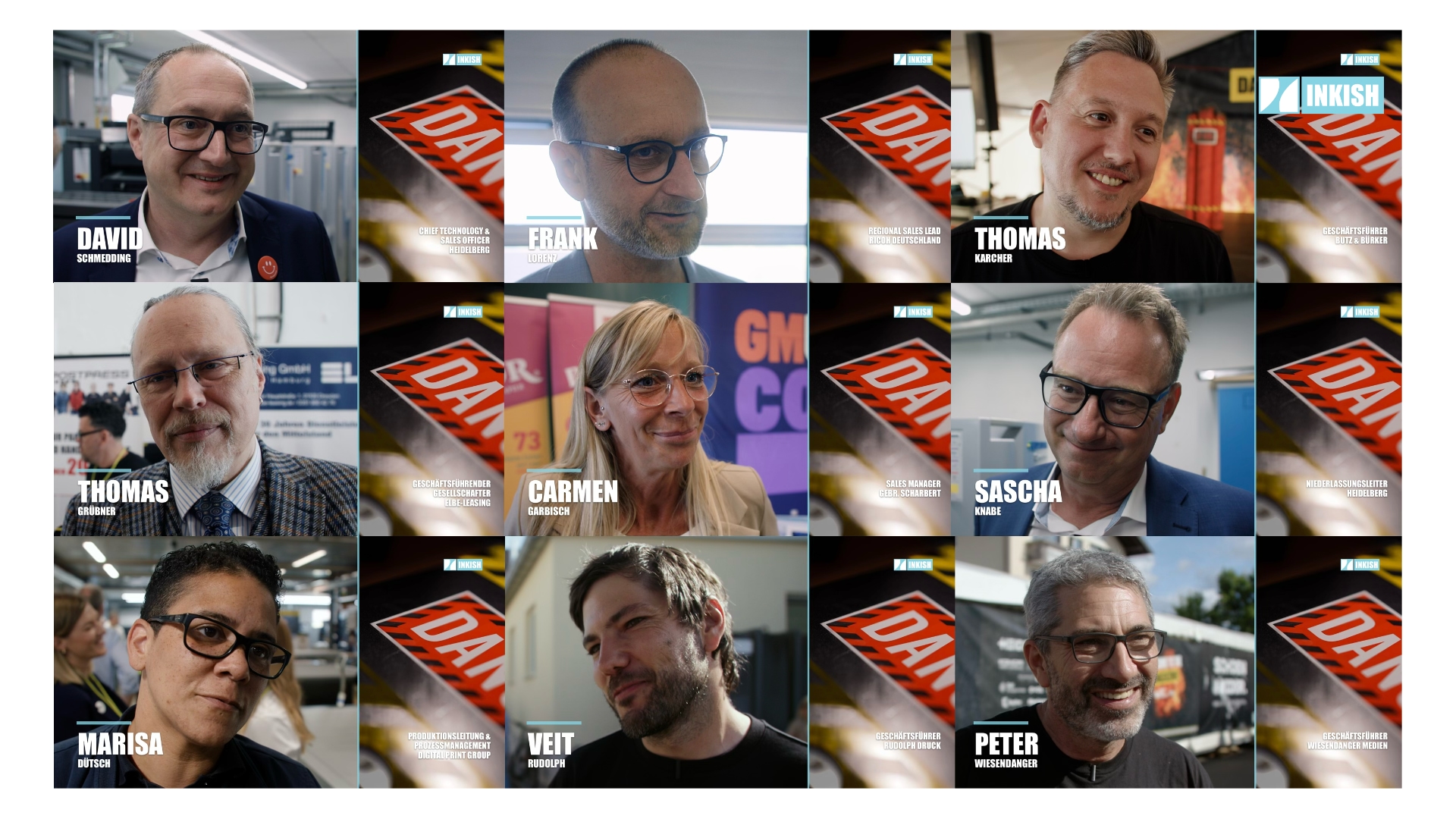
Interview In German Morten Reitoft from INKISH visits the Veit Rudolph Druck Symposium, an event hosted by the German printing company in a spectacular location in the Alps, bringing together printers, suppliers, manufacturers, and industry professionals for open discussions about the future of print. Together with Morten, explore why the event is called “Danger Zone.” Unlike a traditional trade fair, the symposium creates a more honest and relaxed atmosphere where people from across the printing industry can exchange ideas, challenge assumptions, and discuss the realities facing the business today. The conversation also moves into more difficult territory. What happens if major technology suppliers disappear? What happens if customer expectations fundamentally change? Will printing companies still exist in 10 years, and if so, what role will they play? Marisa explains that while companies naturally adapt and evolve, it is important to continuously question existing business models and think beyond traditional printing. Many companies are already discussing how they may need to develop new competencies and services in order to remain relevant in the future. Another important topic is communication. Both Morten and Marisa agree that the printing industry often fails to explain how advanced, creative, and important modern print really is. The discussion touches on whether this responsibility falls to industry associations, individual printers, suppliers, or media platforms such as INKISH. An honest and thoughtful conversation from one of the industry’s more unique networking and discussion events. --- Morten Reitoft von INKISH besucht das Veit Rudolph Druck Symposium, eine Veranstaltung des deutschen Druckunternehmens in einer beeindruckenden Location in den Alpen. Das Symposium bringt Druckereien, Hersteller, Lieferanten und Branchenprofis zusammen, um offen ĂŒber die Zukunft der Druckindustrie zu sprechen. Gemeinsam spricht Morten darĂŒber, warum die Veranstaltung den Namen „Danger Zone“ trĂ€gt. Anders als eine klassische Fachmesse schafft das Symposium eine ehrliche und entspannte AtmosphĂ€re, in der Menschen aus der Druckindustrie Ideen austauschen, bestehende Denkweisen hinterfragen und offen ĂŒber die Herausforderungen der Branche diskutieren können. Das GesprĂ€ch geht dabei bewusst auch in schwierigere Themen hinein. Was passiert, wenn große Technologieanbieter plötzlich verschwinden? Was passiert, wenn sich die Anforderungen der Kunden grundlegend verĂ€ndern? Wird es Druckereien in zehn Jahren ĂŒberhaupt noch geben, und wenn ja, welche Rolle werden sie dann spielen? Marisa erklĂ€rt, dass Unternehmen sich selbstverstĂ€ndlich weiterentwickeln und anpassen mĂŒssen. Gleichzeitig sei es wichtig, bestehende GeschĂ€ftsmodelle immer wieder kritisch zu hinterfragen und ĂŒber den klassischen Druck hinauszudenken. Viele Unternehmen beschĂ€ftigen sich bereits heute intensiv mit neuen Kompetenzen und Dienstleistungen, um auch in Zukunft relevant zu bleiben. Ein weiterer wichtiger Punkt ist die Kommunikation der Branche. Sowohl Morten als auch Marisa sind der Meinung, dass die Druckindustrie oft nicht ausreichend erklĂ€rt, wie modern, kreativ und wichtig Print heute tatsĂ€chlich ist. Dabei stellt sich die Frage, ob diese Aufgabe stĂ€rker von VerbĂ€nden, einzelnen Druckereien, Herstellern oder Medienplattformen wie INKISH ĂŒbernommen werden sollte. Ein ehrliches und nachdenkliches GesprĂ€ch von einer der besonderen Networking- und Diskussionsveranstaltungen der Druckindustrie.

Wed September 28th

En

Marisa DĂŒtsch · Knowledge Management · H...

She knows everything or pretty much everything, and when mentioning it, she brings her entire team into the conversation and tells us that all are binders and have a passion for Horizon and the products - we like it! In this interview, Marisa DĂŒtsch also talks about the importance of being both a driver and market-driven and how important events like Finishing First is for the company. Super interview, you should watch it!

Fri April 24th

En

Marion Williams-Bennett · Over The Skype...

Marion Williams-Bennett is a professional PR/Communication woman with clients in the printing industry. In this 'Over the Skype' session, we talk about the role of PR- and how companies can benefit from working with a professional communications person. Great insight. As with all our ‘Over the Skype’ interviews, quality is limited to bandwidth, web-cams, and ability to literally LIVE mix the conversations. However, it works, and with Over the Skype, we will bring you more than 20 exciting people, and angles on the industry as it is right now. Enjoy!

Mon September 25th

Es

Marine Guelaia & Ripu Bakshi · Hexi...

Talking to Ripu Bakshi, Commercial Director Hexis Graphics Spain Hexis Graphics Spain unveiled new films (chrome, textiles, window tinting, and sun protection). At the stand, we were with Ripu Bakshi, Commercial Director, and Marine Guelaia, Product Manager Hexperience, who showed us the latest interior design and wrapping developments allowing us to comfortably work with vinyl. ___ Ripu Bakshi Director Comercial Hexis Graphics España Hexis Graphics España dio a conocer nuevos films (cromados, textiles, tintado de lunas y protecciĂłn solar). En el stand estuvimos con Ripu Bakshi, Director Comercial y Marine Guelaia, Product Manager Hexperience quienes nos mostrarĂłn las Ășltimas novedades en torno al interiorismo y el wraping que permiten trabajar de manera muy comoda el vinilo.

Thu August 1st

En

Mariania Samanides · Manager · G. Samine...

Jacques from INKISH TV talks to Mariania from Greece at the Weilburger Graphics booth. Mariania's trading company, established in 1948 and based in Athens, supplies the Greek graphic arts industry with all printing-related products except paper and plates. Despite long-standing industry challenges, they’ve adapted well. Their collaboration with Weilburger Graphics began at Drupa 2000, focusing on varnishes, and has grown into a strong partnership. They also represent Zeller+Gmelin inks and provide comprehensive support to their customers, ensuring high-quality products and excellent after-sales service. LinkedIn Profile: https://www.linkedin.com/in/mariania-samanides-964995120/

Thu May 22nd

En

Marg Macleod · Association Manager · DIA...

Marg Macleod is the Association Manager for DIA, the Canadian Digital Imaging Association, and the President of IBEC Consulting. We are speaking with individuals from various countries around the world to share their perspectives on the impact of the Trump Administration's tariffs and the global uncertainty. We begin with Marg Macleod as a neighbor to the US - how does this influence her personally and business-wise, and what impact does it have on the industry? Just an opinion - and we allow ALL opinions (within what's legal, of course) and we are true believers that sharing knowledge, views, and ideas strengthens us. Enjoy a conversation and participate by sharing your views or getting an interview with us at INKISH. You are ALWAYS welcome to write to editor@inkish.tv.

Thu May 7th

En

Marcus Weiss · CEO · Koenig & Bauer...

In this interview, Morten B. Reitoft sits down with Markus Weiss for a discussion that starts with perspective rather than products. Stepping into a company with more than 200 years of history is one thing. Helping shape where it goes next is something else. Markus Weiss brings nearly two decades of experience from HP Inc., where he played a key role in developing digital print across regions, including EMEA. That background is evident in how he approaches the conversation. Change is not something to react to; it is something to manage, and often to lead. The discussion moves quickly beyond technologies. Because the reality, as Weiss explains, is that customers are not buying offset or digital, they are investing in applications, efficiency, and relevance. The challenge is not choosing one over the other, but understanding how they work together. Another important theme is complexity. Large organizations naturally develop silos across locations, technologies, and cultures. Breaking those silos and aligning around customer needs is easier said than done, but essential if companies want to stay competitive in a fast-changing market. There is also a clear acknowledgment of the financial reality. Innovation is not optional, especially for manufacturers operating in Europe. Balancing innovation with cost efficiency is a constant challenge, and one that requires both discipline and long-term thinking. Beyond strategy, the conversation also touches on leadership. Weiss emphasizes the importance of listening, encouraging direct feedback, and building strong relationships, both internally and with customers. It is a pragmatic approach shaped by experience in dynamic, often demanding environments. This is not a product-focused interview. It is a broader conversation about how to lead a company with deep industrial roots into a future defined by change. Watch the full interview with Markus Weiss to hear how experience, adaptability, and a clear focus on customer needs shape the direction of one of the industry’s most established companies.

Sun December 3rd

En

Marcus Thomasfolk · Head of Communicatio...

Thursday morning, our NON-EVENT attendees were welcomed by Head of Communications Marcus Thomasfolk from VW Sweden - and what a presentation. People who know the term 'Gamification' also understand how powerful it can be used to shift behaviors. This was really interesting, so dig in and learn :-)

Fri June 14th

En

Marcus Stickel · CEO · MPrint · Reportin...

In this interview, CEO Marcus Stickel shows the 4-color print bar developed by MPrint to add "hybrid" capabilities to existing presses - i.e., label presses. We saw the prototype at IST UV-Days, but now the product is ready for sale, and it's quite impressive :-) LinkedIn Profile: https://www.linkedin.com/in/marcus-stickel-8b17989a/

Sun February 2nd

En

Marcus Greenbrook · Director, Internatio...

At Printpack India 2025, Wayne Beckett sits down with Marcus Greenbrook, Director of International Sales at GEW, to discuss the company's first appearance at the exhibition and its growing focus on the Indian market. Greenbrook shares how GEW made a late but strategic decision to exhibit, recognizing Printpack India as a major event on par with global exhibitions like Drupa. With India already a strong market for GEW, particularly in flexo printing, the conversation explores the country’s shift towards UV LED technology and its benefits in terms of energy efficiency, cost savings, and performance consistency. Greenbrook provides insights into how Indian manufacturers and OEMs are adopting hybrid UV and LED systems, with the latest AirCooled AeroLED making retrofitting easier and more affordable. He also discusses the cost-effectiveness of LED upgrades, emphasizing the quick return on investment and the long-term advantages over conventional UV systems. For anyone interested in the future of UV curing technology and its impact on the Indian printing industry, this discussion offers valuable insights into innovation, market trends, and the next steps for GEW in this rapidly evolving sector.

Tue May 23rd

En

Marcus Greenbrook · Director, Internatio...

If you say GEW, you also say UV - and as GEW is a partner with Mark Andy, we got the opportunity to talk with Director of International Sales, Marcus Greenbrook, about what GEW offers and how customers are accepting LED-UV as an alternative to the mercury-based lamps. Enjoy!

Fri May 29th

En

Marco Rota · Software & Electrical ...

"It's very difficult", is Marco Rota's instant answer to Editor Morten Reitoft's question about whether it's difficult to program the software that makes the machines work. And as much as we talk about hardware, the computer/programming part grows, not only because of complex machines, but also because the market requires machines easy to operate. As he describes it, the more an operator shouldn't do, the more the programming needs to be in place. Fun and great insights!

Wed April 27th

En

Marco Panzeri · Hybrid Digital Product M...

OMET of Italy has integrated DURST technology into the Hybrid label printer. Marco Panzeri describes the advantages of flexibility with both long and short run jobs. OMET machines with a ‘platform’ concept. It supports printing, finishing and converting any product in one pass.

Wed June 22nd

En

Marco Hanisch · KURZ · KURZ Label Weeks...

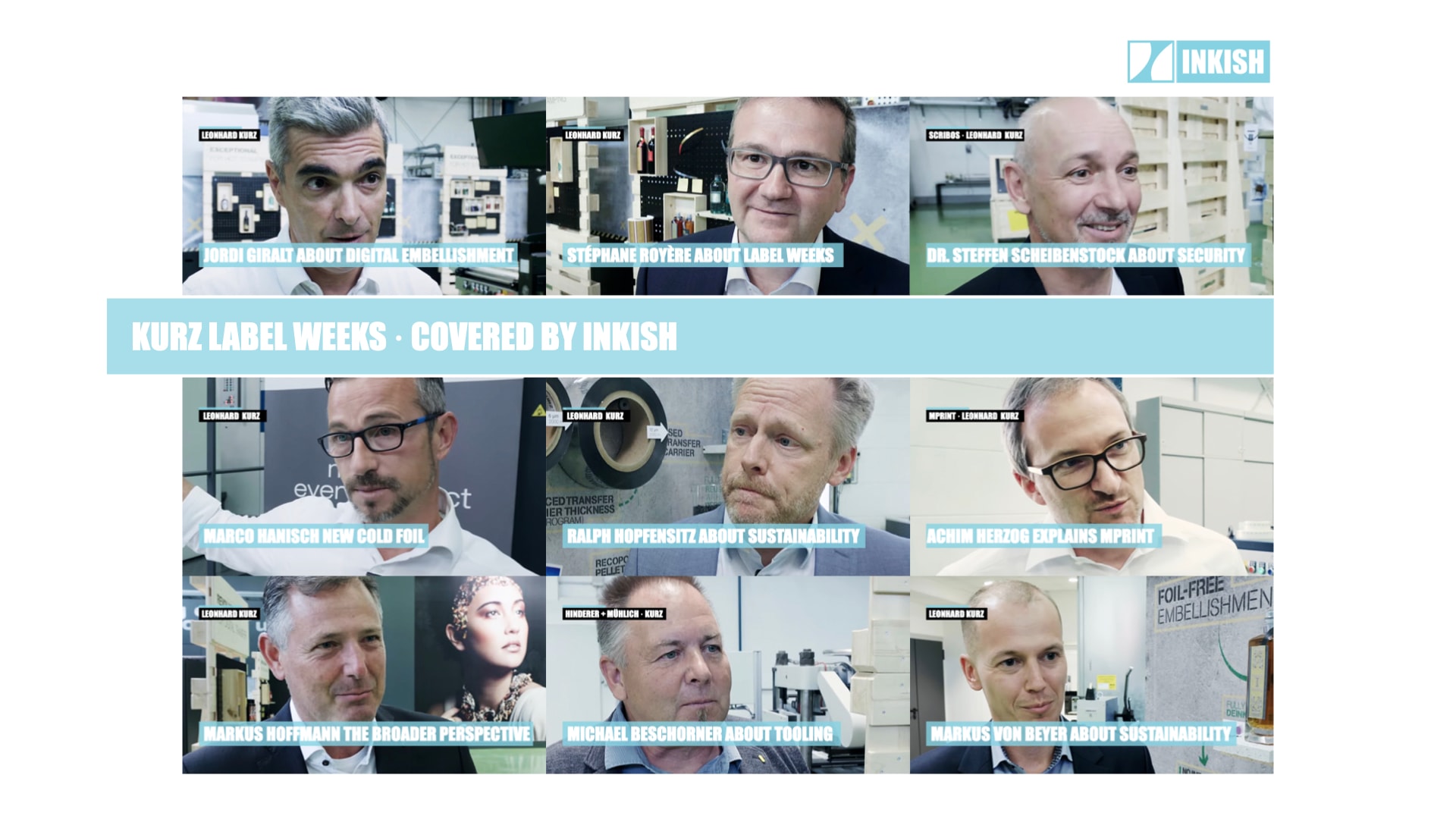
Amazing how cold foil with all its amazing capabilities is a real business opportunity for PSPs, and in this film, Marco Hanisch explains how the new thin foil gives PSPs further advantages. Enjoy the film!

Tue June 11th

En

Marco Hanisch · Head of Global Business ...

This is the second time Editor Morten B. Reitoft has had the pleasure of talking to Marco Hanisch - and this time again about the thin carriers. We say foils, but it should be metalization, as the foil is only the carrier of the metal. By reducing the thickness of the carrier, the rolls can hold more metalization, and therefore already a saving in space and transport. Still, in this film, Marco Hanisch explains that the new thinner carrier also offers customers a productivity gain - but see the interview yourself!  

Thu March 21st

En It

Marco Capoferri · SEI Laser · Stratego G...

Interview by Stratego Group, Alexia Rizzi Production by INKISH LinkedIn Profile Marco Capoferri: https://www.linkedin.com/in/marco-capoferri/

Mon September 6th

En

Marco Calcagni · Sales Director · OMET...

Marco Calcagni has worked with OMET for a long time, and in this 'Conversations' with editor Morten B. Reitoft, he, among other things, talks about the 'defining moment' for OMET. "When our competitors go one way, we go the other way," on why OMET is a success in the flexible/packaging business. OMET, just weeks before our visit, moved to a new build facility with more space for continuing growth - all in all, an inspiring visit in North Italy! LinkedIn Profile Marco Calcagni: https://www.linkedin.com/in/marco-calcagni-28bb5b31/