





















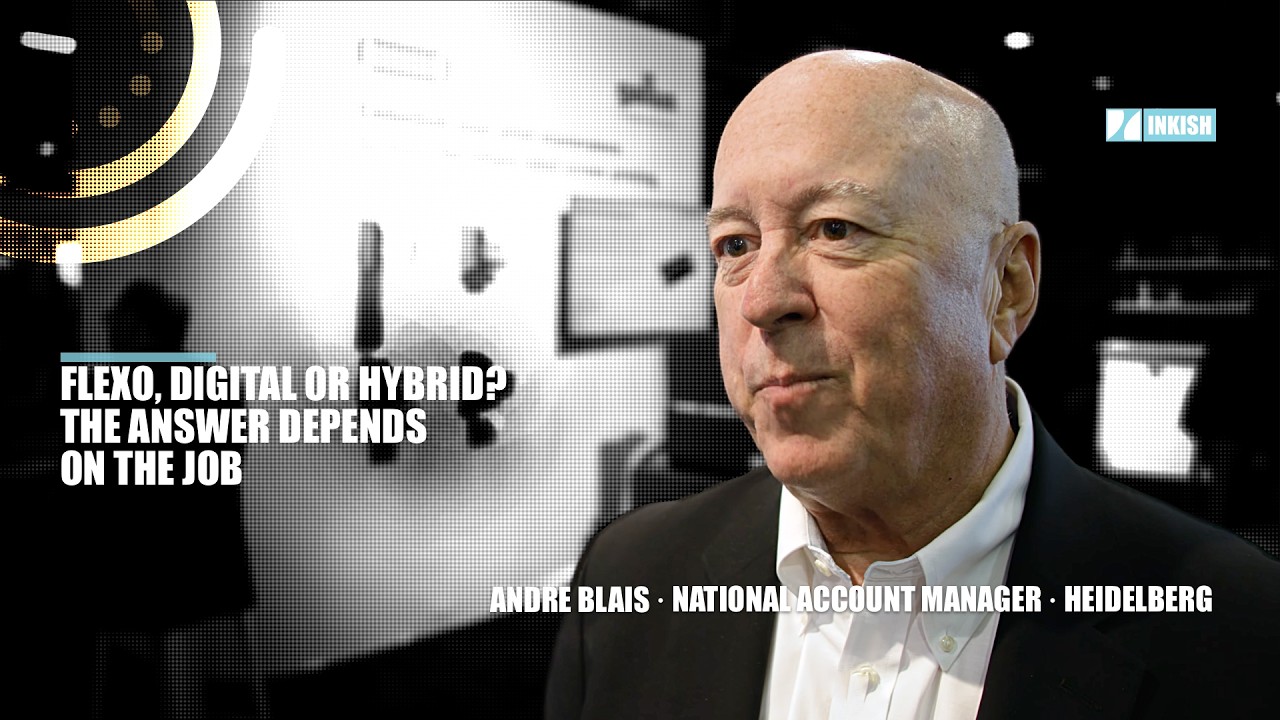
Flexo, Digital or Hybrid? The Answer Depends on the Job · Andre Blais · National Account Manager
Flexo isn’t disappearing.
Digital isn’t taking everything over.
And hybrid increasingly gives converters the opportunity to combine the strengths of both.
At LOUPE Americas in Chicago, Morten B. Reitoft meets Andre from Gallus/Heidelberg to talk about how label production is evolving — and why having access to several technologies is becoming increasingly important.
Andre has worked with Gallus since 2004 and today handles Gallus products across the US, Canada, and Mexico. During that time, he has seen digital label production develop dramatically.
Speed has increased. Quality has improved. Color gamut has expanded. And applications that would have been difficult to imagine digitally only a few years ago are now becoming everyday production.
Gallus can today combine CMYK with white, orange, and violet, achieving a very broad color gamut while running at production speeds that continue to approach those of conventional technologies.
But digital is only part of the equation.
Hybrid configurations can combine digital printing with flexo units, screen printing, cold foil, hot foil, lamination, embossing, and other embellishment processes inline. Some customers even configure presses with multiple flexo units before and after the digital engine, allowing the same platform to run conventional flexo, digital-only, or hybrid production depending on the job.
And the market is also moving wider.
Gallus has expanded from its traditional 13-inch platforms into 17-inch production, with wider configurations expected as converters increasingly look toward applications such as flexible packaging and pouches.
One company investing heavily in Gallus technology is Brook + Whittle.
Across its growing network of operations, the company has been replacing older assets with Gallus Labelmaster presses and has recently added a Gallus One digital press for its Tennessee operation.
For Andre, those projects are not simply about selling another machine.
They start with understanding how the customer actually produces work.
At Brook + Whittle’s St. Louis operation, for example, the configuration of Gallus screen-printing units reduced web-path complexity compared with older equipment — creating significant savings in setup waste and material consumption.
That is where experience becomes important.
A newer press may offer faster speeds, but productivity gains increasingly come from automation, servo technology, shorter setup times, reduced waste, easier operation, and the ability to move between applications with fewer manual processes.
In this INKISH film, Morten talks with Andre about flexo, digital and hybrid production, expanded gamut, embellishment, wider webs, Brook + Whittle, automation, and why the right technology decision isn’t necessarily about choosing one printing process over another.
It’s about choosing the best process for the work in front of you.



No Data Found.
Content for this section will appear here once available
Thu September 17th
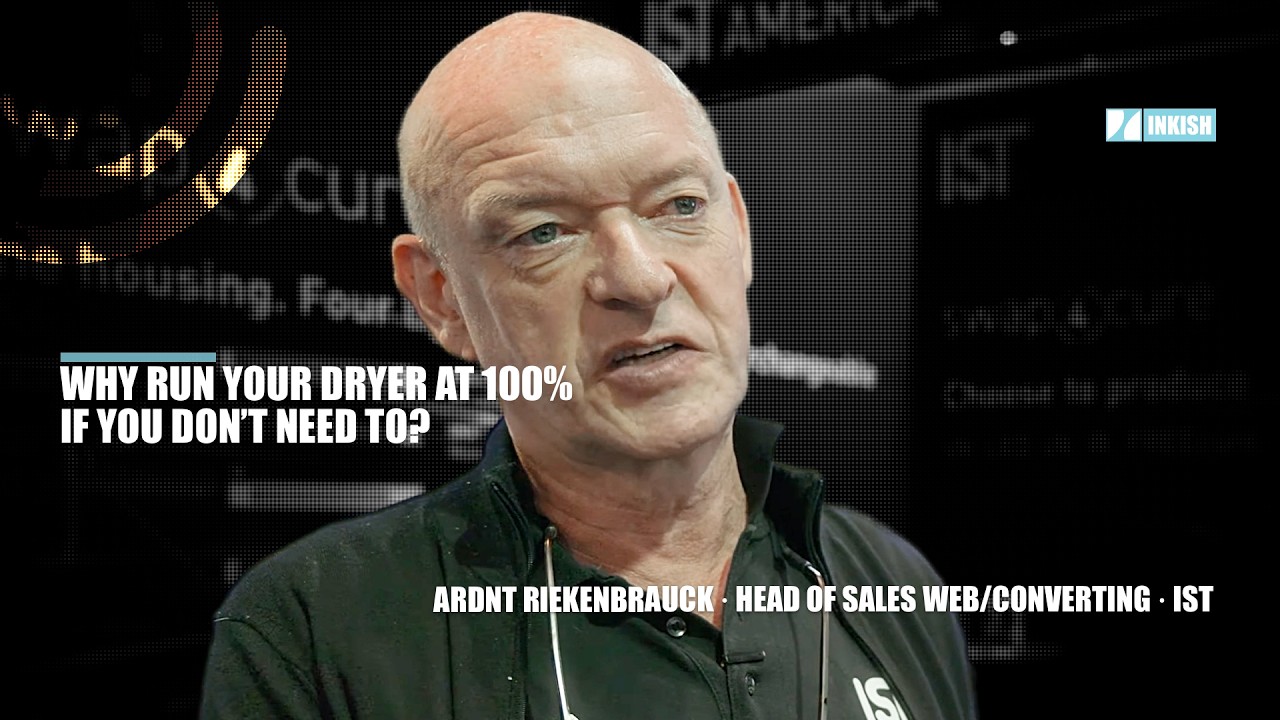
Why Run Your Dryer at 100% If You Don’t Nee...
Walk into many printing plants, and there is a simple approach to curing: Turn the dryer up to 100%. It works. Nobody wants to risk insufficient curing. But it isn't necessarily the smartest or most energy-efficient way to produce. At LOUPE Americas in Chicago, Wayne Beckett meets Anne from IST METZ to talk about the company's new SwapCure platform — shown publicly for the first time at the event — and several technologies that could change how converters think about curing. Flexibility is central to SwapCure. The platform is designed to enable converters to switch between different curing technologies, including infrared, LED, and conventional UV, depending on the application and production requirements. But perhaps one of the most interesting developments is FreeCure. Developed in collaboration with BASF, FreeCure enables UV curing without conventional photoinitiators, addressing a challenge that has traditionally limited UV technology in sensitive applications such as food packaging. IST METZ already has installations operating with the technology in flexible packaging, where reducing concerns around migration and odor can open opportunities for UV in applications where converters may previously have been reluctant to use it. Then there is SmartCure. Rather than simply setting every dryer to maximum power, SmartCure uses production information to predict the curing energy required for a particular job. Job parameters can be used to establish the dryer settings before production begins, and those settings can subsequently be stored and reused when the same work returns. That potentially means lower energy consumption, more repeatable production and — particularly for companies operating multiple sites — a more standardized approach to curing. It is another example of how AI can play a very practical role in print production: not generating content, but using production data to make equipment operate more intelligently. In this INKISH film, Wayne talks with Anne about SwapCure, FreeCure, SmartCure, LED, conventional UV, food packaging, energy consumption, and why curing technology is becoming considerably more flexible — and considerably smarter. Because sometimes improving production isn't about adding more power. It's about knowing exactly how much power you actually need.