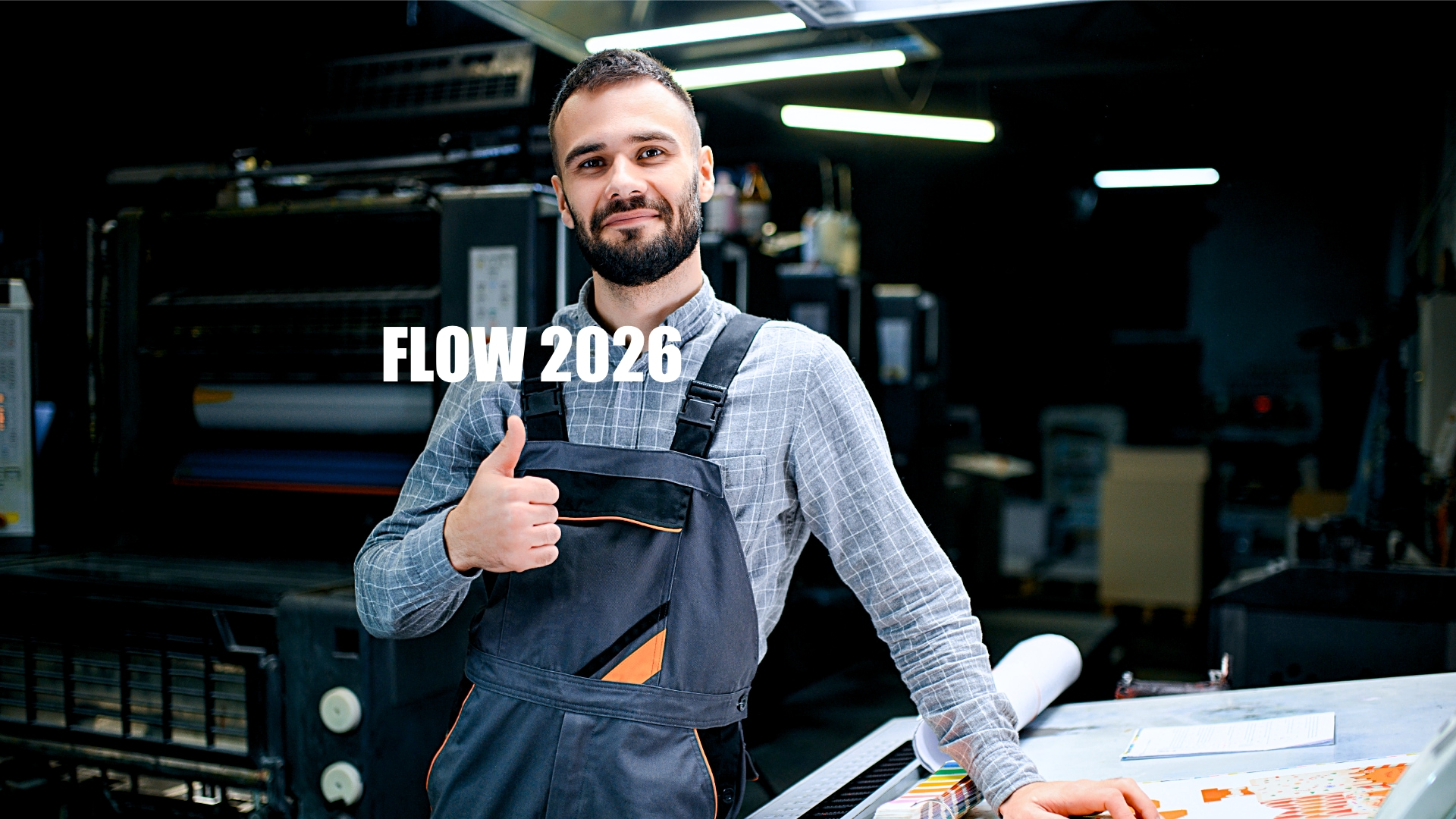
FLOW 2026

En

Who Built FLOW? Meet the Man Behind the Exhibition · Kor Schokker · FLOW 2026

What does it take to transform a working print factory into an exhibition — and then take everything down again just a few days later?

On the final day of FLOW 2026 in Bad Hersfeld, INKISH's Morten Reitoft meets Kor Schokker from Schokker Producties, the man whose team built the exhibition environment that brought FLOW to life at Probo's production facility.

For Kor and his team, exhibition construction is nothing new. But transforming an entire factory into a professional, welcoming exhibition with a consistent visual identity, numerous exhibitors, and thousands of details to coordinate is quite another challenge.

Schokker Producties is a Dutch company specializing in exhibition construction, signage, vehicle wrapping, interior applications, and visual communication. With a team of approximately 15 people, the company serves customers primarily in the Netherlands while following them to exhibitions internationally.

Kor also shares an interesting perspective on his long-standing relationship with Probo. Rather than operating his own large-scale printing facility, he relies on Probo as a trusted production partner, providing quality, competitive pricing, and fast delivery. It's a relationship that demonstrates how specialization and outsourcing can work together successfully.

And sustainability is an important part of the story. The exhibition structures are designed for reuse, enabling the creation of impressive environments without starting from scratch each time.

As FLOW comes to an end, Kor and his team are already preparing for their next project, building an exhibition for agricultural robotics specialist Lely.

A conversation about craftsmanship, collaboration, sustainable exhibition construction, and the people behind the scenes who make events like FLOW possible.

Recorded at FLOW 2026 · Bad Hersfeld, Germany · INKISH

En

A Trade Show Inside a Working Print Factory · Leon van der Meer · Probo · FLOW 2026

What happens when you invite the printing industry into a fully operational print factory, build an entire exhibition inside it, and let visitors experience real production while the machines keep running?

On the final day of FLOW 2026 in Bad Hersfeld, INKISH's Morten Reitoft meets Leon van der Meer, CEO of Probo, to reflect on a remarkable collaboration between Probo and INKISH — and to explore the philosophy behind one of Europe's most interesting print production businesses.

Probo started 25 years ago as a traditional sign company before transforming itself into a digital printing business focused entirely on resellers. Since adopting its reseller model in 2008, the company has grown by helping its customers develop their own businesses rather than competing with them.

For Leon, growth isn't necessarily the objective. It's the result of doing the right things, building strong relationships, delivering quality, and creating opportunities for customers to succeed.

And that philosophy is visible throughout FLOW.

Instead of presenting technology in a conventional exhibition hall, Probo opened its factory doors, allowing visitors to experience real manufacturing, meet the people operating the equipment, and understand how printing, automation, and craftsmanship come together in everyday production.

The conversation also explores Probo's commitment to sustainability, including its initiatives around PVC recycling, its connection to the local community, and the importance of creating an environment where employees feel proud of their work.

Leon and Morten reflect on previous collaborations, including Probo's Printing Wonderland event, and discuss why shared values, attention to detail, and a willingness to execute ambitious ideas have made their partnership so successful.

Perhaps the most powerful message comes from the factory floor itself: behind every impressive technology, every efficient workflow, and every successful printing business are people who care about what they do.

A warm and inspiring conclusion to FLOW 2026, celebrating collaboration, creativity, real production, and the people who made the event possible.

Recorded at FLOW 2026 · Probo · Bad Hersfeld, Germany · INKISH

De

Create a Print Product in One Minute with AI · Nico Olejniczak · CloudLab · FLOW 2026

Imagine creating a complete print product in your online store simply by telling an AI assistant what you want. No complicated configuration, no endless setup screens — just describe the product, and the system does the work.

At FLOW 2026 in Bad Hersfeld, INKISH's Morten Reitoft meets Nico Olejniczak, Chief Commerce Officer at CloudLab, for a conversation about the future of web-to-print, artificial intelligence, and how technology is making it easier for printers to sell their products online.

CloudLab has been developing web-to-print solutions for more than a decade, with its portfolio now including printQ for online print sales, packQ for packaging, and brandQ for marketing and brand management.

One of CloudLab's defining strengths is customization. Rather than offering identical webshops to every customer, the company develops solutions adapted to different business models, product portfolios, and customer requirements — from smaller printing companies to major online print providers.

But AI is creating new possibilities.

Nico explains how CloudLab is preparing a new generation of AI-powered functionality that can assist customers with design creation, recognize existing branding, and use additional AI models to check whether artwork is suitable for production.

Even more interesting is AI working behind the scenes. Instead of manually configuring a new print product, users can describe something as simple as a four-page DIN-long flyer. The system can then generate the product structure, select materials, and prepare the configuration for online sales — potentially within a minute.

The conversation also explores CloudLab's sophisticated online editors, interactive 3D previews for packaging and exhibition applications, and the importance of connecting online sales with pricing, calculation, and production systems.

For printing companies, this represents an interesting shift. Web-to-print is no longer just about putting a product catalog online. It's increasingly about removing complexity for both customers and employees, making print easier to design, configure, order, and produce.

A fascinating look at how AI could transform web-to-print from a complex software environment into a more intuitive and accessible way of doing business.

Recorded at FLOW 2026 · Bad Hersfeld, Germany · INKISH

En

A Fast Press Means Nothing Without Efficient Finishing · Peter Minis · Komori · FLOW 2026

What happens when someone who learned to operate a guillotine in his father's printing company sees two industrial robots doing the same job automatically?

At FLOW 2026 in Bad Hersfeld, INKISH's Morten Reitoft meets Peter Minis from Komori for an engaging conversation about robotics, artificial intelligence, finishing automation, and how the printing industry is changing.

Peter has a personal connection to print finishing. Growing up around his father's printing company, one of his first jobs was operating a guillotine. Decades later, he finds himself at FLOW, where Komori, MBO, and Yaskawa are demonstrating a robotic cutting solution designed to eliminate repetitive manual handling and improve production efficiency.

For Peter, the benefits are immediately recognizable. He knows the physical demands of working at a guillotine, but he also understands the importance of precision, reliability, and consistent throughput.

The conversation explores why combining Yaskawa's industrial robotics expertise with Komori and MBO's understanding of printing and finishing creates new possibilities for automation.

But the discussion goes far beyond the robots.

Peter explains how the industry is moving away from evaluating individual machines toward understanding the productivity of the entire production environment. A printing press can be incredibly fast, but if finishing becomes a bottleneck, the overall result is still inefficient.

Software and artificial intelligence are accelerating this transformation. At FLOW, Peter and his colleagues even used AI to develop a practical lead-registration application, demonstrating how quickly new tools can be created to solve everyday business problems.

And as Komori expands its portfolio beyond printing presses, the company is opening conversations with customers who may use competing press technologies but still need better finishing and automation solutions.

Peter also shares his impressions of FLOW, particularly the openness, enthusiasm, and genuine interaction between exhibitors and visitors — something he believes distinguishes the event from traditional trade shows.

A conversation about embracing new technology, connecting production processes, and why the future of print profitability depends on the performance of the entire factory, not just the speed of the printing press.

Recorded at FLOW 2026 · Bad Hersfeld, Germany · INKISH

De

Print Has a Marketing Problem, Not a Technology Problem · Rüdiger Maaß · WE.LOVE.PRINT

The printing industry has spent decades becoming more efficient, more automated, and more technologically advanced. But have we spent enough time explaining to customers why print matters? At FLOW 2026 in Bad Hersfeld, INKISH's Morten Reitoft meets Rüdiger Maaß, Managing Director of Fachverband Medienproduktion (FMP) and co-founder of WE.LOVE.PRINT, for a conversation that goes beyond workflow automation and robotics to address one of the printing industry's biggest challenges: communicating the value of print. Through WE.LOVE.PRINT, Rüdiger and his partners are working to strengthen the position of print in society, bringing together industry organizations, manufacturers, printers, and other stakeholders to promote the possibilities of printed communication. From creative applications and personalization to finishing, embellishment, and brand experiences, the initiative aims to demonstrate what print can achieve — not just to people already working in the industry, but to designers, agencies, marketers, brand owners, and ultimately the general public. But Rüdiger raises an important concern. While the industry has become exceptionally good at discussing standards, color management, production efficiency, and automation, these are rarely the things that interest print buyers. Customers don't necessarily care which machine produces their printed materials. They care about what the finished product communicates, how it engages people, and what value it creates for their businesses. The conversation also explores whether the printing industry makes ordering print unnecessarily complicated compared with digital marketing, where creating, launching, and measuring campaigns has become increasingly accessible. And there's a direct connection to profitability. If printers cannot communicate the value of what they produce, price becomes the easiest point of comparison — and differentiation becomes increasingly difficult. Rüdiger argues that the industry has enormous potential, but realizing it requires a different conversation with the market. Better technology is essential, but creating demand, communicating benefits, and inspiring customers are equally important. A thought-provoking discussion about the future of print, the role of industry collaboration, and why selling the value of print may be just as important as automating its production. Recorded at FLOW 2026 · Bad Hersfeld, Germany · INKISH

De

From Cutting Robots to Humanoids · Florian Kohut · Yaskawa · FLOW 2026

What happens when one of the world's largest robotics manufacturers discovers the enormous automation potential of the printing industry? And how far away are we from robots that can recognize, learn, and adapt to new tasks on their own?

At FLOW 2026 in Bad Hersfeld, INKISH's Morten Reitoft meets Florian Kohut from Japanese robotics giant Yaskawa to discuss industrial automation, the company's collaboration with Komori and MBO, and the next generation of intelligent robotics.

Yaskawa has decades of experience supplying industrial robots to industries ranging from automotive manufacturing to food and pharmaceuticals. But as Florian explains, the printing industry offers significant opportunities, particularly in the processes surrounding printing presses, where manual handling, repetitive movements, and material transport continue to create bottlenecks.

At FLOW, Yaskawa and Komori demonstrate a fully automated guillotine solution, combining industrial robotics with printing industry expertise. Rather than simply supplying a robot to be programmed by an integrator, Yaskawa works closely with Komori and MBO to develop a complete solution built around actual customer requirements.

And what looks relatively simple from the outside involves sophisticated engineering, software integration, data exchange, and precise robotic movements.

The conversation also explores how artificial intelligence, faster processors, and advanced sensors are opening new possibilities for robotics. Florian describes Yaskawa's development of adaptive robotic systems incorporating NVIDIA technology, enabling robots to recognize objects and potentially learn new skills.

And then there's the question everyone is asking: humanoid robots.

Florian shares Yaskawa's ambitions to introduce humanoid robot pilots in the coming years, with broader commercialization targeted around 2030. While the applications are still being explored, he believes humanoids will eventually find their place alongside established industrial robotics.

An interesting conversation about partnerships, practical automation, intelligent robotics, and why the printing industry's next productivity improvements may come from everything happening around the printing press.

Recorded at FLOW 2026 · Bad Hersfeld, Germany · INKISH

De

Automation Is Easy. Autonomous Production Is the Real Challenge · Jörg Daehnhardt · Heidelberg

What happens when printing presses become faster, print runs become shorter, and every single sheet could be a different job? The real challenge may no longer be printing — but everything that happens afterward.

At FLOW 2026 in Bad Hersfeld, INKISH's Morten Reitoft meets Jörg Daehnhardt from Heidelberg for an interesting conversation about robotics, automated finishing, and the transition from automated processes to truly autonomous print production.

Heidelberg demonstrates one of its compact, flexible robotic stacking solutions, giving visitors an opportunity to explore the details that can make a significant difference in everyday production. From palletizing capacity and mobility to the ability to adapt to different production requirements, Jörg explains why seemingly small technical differences can have a substantial impact on productivity.

But the conversation quickly moves beyond robotics.

With Heidelberg's growing portfolio of digital printing solutions, including Jetfire 50 and Jetfire 75, the company faces an increasingly important challenge: how to finish digitally printed products efficiently when production moves toward ultra-short runs and even a product of one.

That's where Heidelberg's Stahlfolder Fireline enters the picture.

Designed for automated digital print finishing, Fireline connects folding, cutting, and workflow technology to help printers move from printed sheets toward finished products with fewer manual interventions. Through integration with other finishing technologies, Heidelberg is developing an increasingly connected production environment that can accommodate different product types, workflows, and customer requirements.

Jörg also introduces an important distinction between automation and autonomous production. Automating an individual process is one thing. Creating a production environment that can manage job changes, maintain quality, and operate reliably with minimal intervention is something considerably more demanding.

And Heidelberg recognizes that no single manufacturer can provide every solution. By working with finishing partners and supporting interfaces to other equipment, the company is increasingly positioning itself as a systems integrator rather than simply a supplier of individual machines.

A fascinating conversation about robotics, digital finishing, open integration, and why the next major productivity improvements in printing may depend on everything that happens after the sheet leaves the press.

Recorded at FLOW 2026 · Bad Hersfeld, Germany · INKISH

En

The Walk · A Guillotine That Runs Without an Operator? · Jacob Hummel · Komori & Yaskawa · FLOW 2026

What if a guillotine could receive a stack of printed sheets, calculate the cutting sequence, position the paper, perform every cut, and deliver the finished stacks — without an operator?

At FLOW 2026 in Bad Hersfeld, INKISH's Morten Reitoft meets Jacob Hummel, Chief Commercial Officer of Komori Europe, for a demonstration of a fully automated guillotine solution developed through a collaboration between Komori and Japanese robotics specialist Yaskawa.

While printing presses have become increasingly faster and more automated, cutting remains one of the most labor-intensive processes in many printing companies. Heavy paper stacks, repetitive handling, manual positioning, and constant operator involvement can create significant bottlenecks between printing and finishing.

Komori and Yaskawa are addressing this challenge by combining a conventional industrial guillotine with two powerful robotic arms and an intelligent automation system.

Using production information originating from the imposition workflow, the system can determine cutting sequences, move and position paper stacks, perform consecutive cuts, and manage the resulting stacks. And because the robotic automation is designed as a separate system, it can potentially be integrated with compatible guillotines from different manufacturers.

But the real opportunity goes beyond replacing manual labor.

Jacob explains how predictable throughput, continuous operation, reduced operator fatigue, and better production planning can improve the economics of finishing. The system also opens interesting possibilities for future development, including vision technology capable of identifying printed content, checking dimensions, and supporting automated sorting.

The conversation concludes with a live demonstration of the robotic cutting system — showing how technologies from two Japanese manufacturers can work together to eliminate one of print production's most persistent manual bottlenecks.

A fascinating look at robotics, industrial automation, and the future of autonomous print finishing.

Recorded at FLOW 2026 · Bad Hersfeld, Germany · INKISH
En

Even Competitors Are Welcome! · Matthias Annaheim · Hunkeler Innovationdays 2027

What happens when one of the printing industry's most established events opens its doors even wider — including to direct competitors?

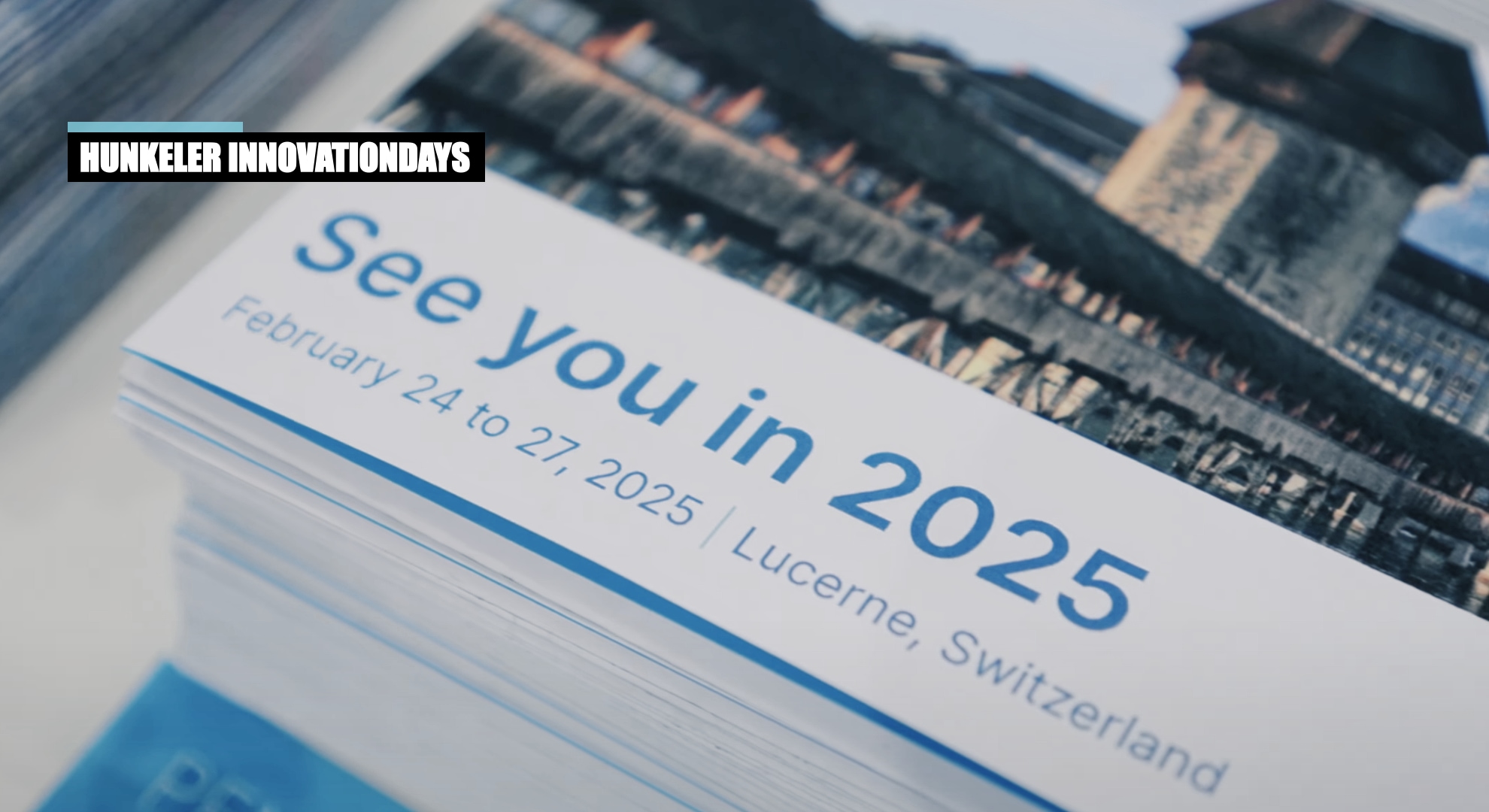
At FLOW 2026 in Bad Hersfeld, INKISH's Morten Reitoft meets his good friend Matthias Annaheim from Hunkeler for a conversation about the upcoming Hunkeler Innovationdays, taking place February 22–25, 2027, in Lucerne, Switzerland.

The 16th edition marks an important milestone. For the first time, Hunkeler and Müller Martini are organizing the event together following their merger, bringing their combined expertise into an exhibition known for live demonstrations, connected production solutions, and practical innovation.

And this time, something else is changing.

Hunkeler Innovationdays is opening its doors to competitors, reinforcing its position as a meeting place for the entire printing industry rather than simply a showcase for individual manufacturers. As Matthias explains, the future of print depends on collaboration, sharing knowledge, and connecting technologies across traditional company boundaries.

The theme for 2027 is "imPRESSed" — a promise that visitors will discover technologies, applications, and ideas that leave a lasting impression.

Matthias also shares encouraging early registration figures, with approximately one-third of registered visitors being newcomers to the event. It's an interesting indication that Hunkeler Innovationdays continues to attract new audiences while maintaining its loyal following.

The conversation also touches on what goes into organizing successful industry events, the importance of a relaxed and welcoming atmosphere, and how FLOW and Hunkeler Innovationdays share a belief in bringing people together around real technology and meaningful conversations.

And yes, INKISH will once again contribute its printed magazine, demonstrating what's possible when digital printing, automation, and finishing come together.

A friendly conversation about innovation, cooperation, and why the best industry events are about much more than machines.

Recorded at FLOW 2026 · Bad Hersfeld, Germany · INKISH
En

AI Won’t Save Your Print Business If Your Data Is Wrong · Stephan Reiter · CAI Software · FLOW 2026

Can you name your 20 most profitable printing jobs from the past six months? If not, you might have a bigger problem than outdated software.

At FLOW 2026 in Bad Hersfeld, Pat McGrew meets Stephan Reiter from CAI Software to discuss why the future of print management isn't simply about implementing new technology, but understanding the economics and processes behind every printing job.

With roots in EFI and eProductivity Software, CAI brings together an extensive portfolio of MIS, ERP, web-to-print, and workflow solutions serving printing companies of every size, from small businesses to multinational enterprises.

But Stephan challenges the traditional way printers approach software investments. Rather than starting with a list of desired features, he asks fundamental business questions: Which jobs actually make money? How much capital is tied up in unused inventory? Where are employees spending time on unnecessary manual processes?

CAI uses time-and-motion studies to examine workflows, often tracing completed invoices backward through production, estimating, and order entry to uncover hidden inefficiencies.

And what about artificial intelligence?

While CAI is developing AI-powered capabilities for onboarding, estimating, migration, and reporting, Stephan is clear that AI alone cannot solve structural problems. Without accurate data and well-defined processes, even the most sophisticated technology will struggle to deliver meaningful results.

The conversation also explores why printing companies should reconsider legacy MIS installations that may have served them well for years but no longer reflect their business needs.

With changing customer expectations, increasing automation, and growing competitive pressure, Stephan argues that printers need to understand their profitability and rethink how their entire business operates.

A thought-provoking conversation about the real value of MIS, the limitations of AI, and why the printing companies that understand their numbers may be the ones best prepared for the future.

Recorded at FLOW 2026 · Bad Hersfeld, Germany · INKISH