


















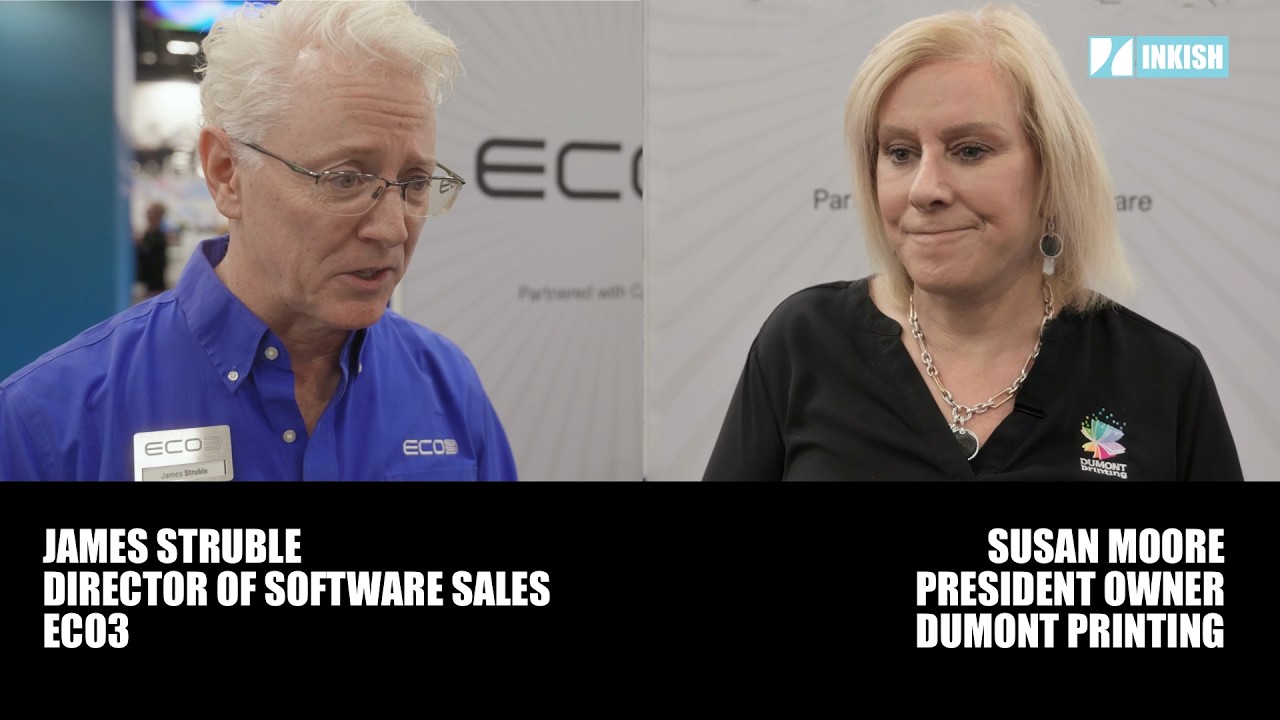
Susan Moore & James Struble Dumont & ECO3
Everybody talks about workflow automation, but what does it actually mean inside a real printing company where offset, digital, web-to-print, MIS, proofing, and production all have to work together?
At PRINTING United in Las Vegas, Pat McGrew meets Susan Moore, President and Owner of Dumont Printing, for a conversation about a transformation underway that her company.
Dumont has been an Apogee and ePS Pace user for years, and on the offset side, the integration is already working extremely well. Customer service can receive a file, preflight it, create the proof, and move the job through Apogee and on toward plate production using JDF/JMF connectivity.
But digital changes the equation.
Dumont operates multiple digital workflows and customer storefronts, and Susan explains that connecting everything from Pace through Apogee to the various digital production environments and Fiery front ends has proven considerably more challenging.
The objective, however, is very clear: when a customer submits a file, Dumont wants to create an almost immediate proof and then move as much of that job through production as possible with little or no human intervention.
And Susan makes an important point about the economics of automation. The large offset jobs may have more value, but it is often the $150 or $200 digital job that absolutely cannot afford multiple people touching it. As turnaround expectations continue to shrink, removing unnecessary manual steps becomes essential to maintaining profitability.
Following the conversation with Susan, Pat speaks with James Struble from ECO3 about how the company is working with Dumont to close those workflow gaps.
The process starts before prepress. Customer service can compare incoming files against the estimate and identify fundamental production information such as page count, finished size, bleed and special colors before the job reaches production. Once the information and file are connected to the Pace job, they can be transferred into Apogee, where the job can be imposed and prepared for web-based proofing dramatically faster than through a conventional manual workflow.
But automation isn’t only about producing more with fewer people.
James makes another interesting observation: better workflow can reduce stress inside a printing company. When processes are predictable, information is available where it is needed, and repetitive tasks happen automatically, experienced employees spend less time firefighting. In an industry where skilled people can be extremely difficult to replace, that has value far beyond simple productivity calculations.
The conversation also introduces ECO3’s Advanced Job Restoration functionality. When customer service identifies a job that needs to be reproduced, information can flow from Pace into Apogee, automatically retrieve the archived production elements and prepare the job for output — eliminating another series of manual steps.
Dumont’s journey is still very much in progress, and Susan is refreshingly realistic about that. Automation requires investment, resources and significant effort from employees before the benefits appear.
But the destination is obvious.
Fewer touches. Faster turnaround. Better information. Less stress. And an automated production environment where even a $150 digital job can make economic sense.
Watch Pat McGrew with Susan Moore from Dumont Printing and James Struble from ECO3 at PRINTING United 2026 in Las Vegas.


No Data Found.
Content for this section will appear here once available
Fri September 25th
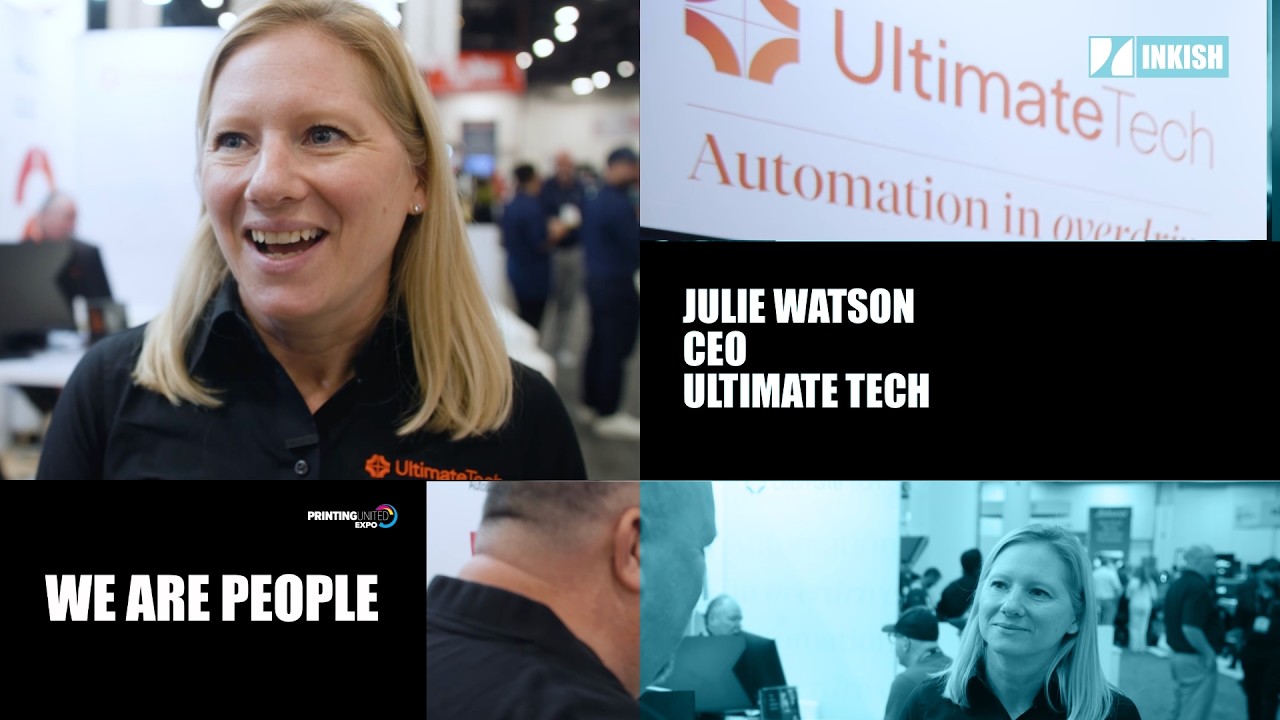
Julie Watson · CEO · Ultimate Tech
At PRINTING United 2026 in Las Vegas, Morten B. Reitoft meets longtime friend Julie Watson, CEO of Ultimate Tech, for a conversation that has very little to do with products — and everything to do with the leadership required to create them. Julie grew up around the printing industry and eventually took over the family company founded by her father. But taking over didn't mean simply continuing what already existed. Ultimate had to reinvent parts of its technology, invest in an entirely new platform and make decisions based not only on what customers needed today, but where the industry might be ten years from now. One of those decisions was moving Ultimate Impostrip toward an HTML5-based architecture. At the time, Julie remembers considerable internal discussion and pushback. But that technology decision ultimately helped create the foundation for today's multi-platform, cloud and containerized environments. And that raises an interesting leadership question: What happens when the team doesn't immediately agree with the direction? For Julie, leadership isn't about ignoring those concerns. Disagreement can reveal real problems that need to be addressed. The objective is to create enough alignment that when a decision is finally made, the team moves forward together. “You can go fast alone, but you go far together” is a philosophy she clearly believes in. Morten and Julie discuss making difficult decisions, accepting accountability, learning from other leaders, peer groups and books, and why Julie doesn't believe in simply trying to become the next Steve Jobs — or anyone else. Instead, she focuses on values. Collaboration. Innovation. Diversity. Curiosity. And creating an organization where people feel part of the direction rather than simply being told where to go. The conversation also touches on one of the differences between family-owned and financially driven companies. Short-term revenue will always matter, but Julie believes leadership also requires making decisions that may take years to deliver their full value — particularly when developing technology for an industry changing as quickly as print. Products don't simply appear on a trade-show floor. Behind every new platform, workflow or innovation are people making decisions about technology, investment, culture and the future. Watch Morten B. Reitoft's conversation with Julie Watson from Ultimate Tech at PRINTING United 2026 in Las Vegas.