



















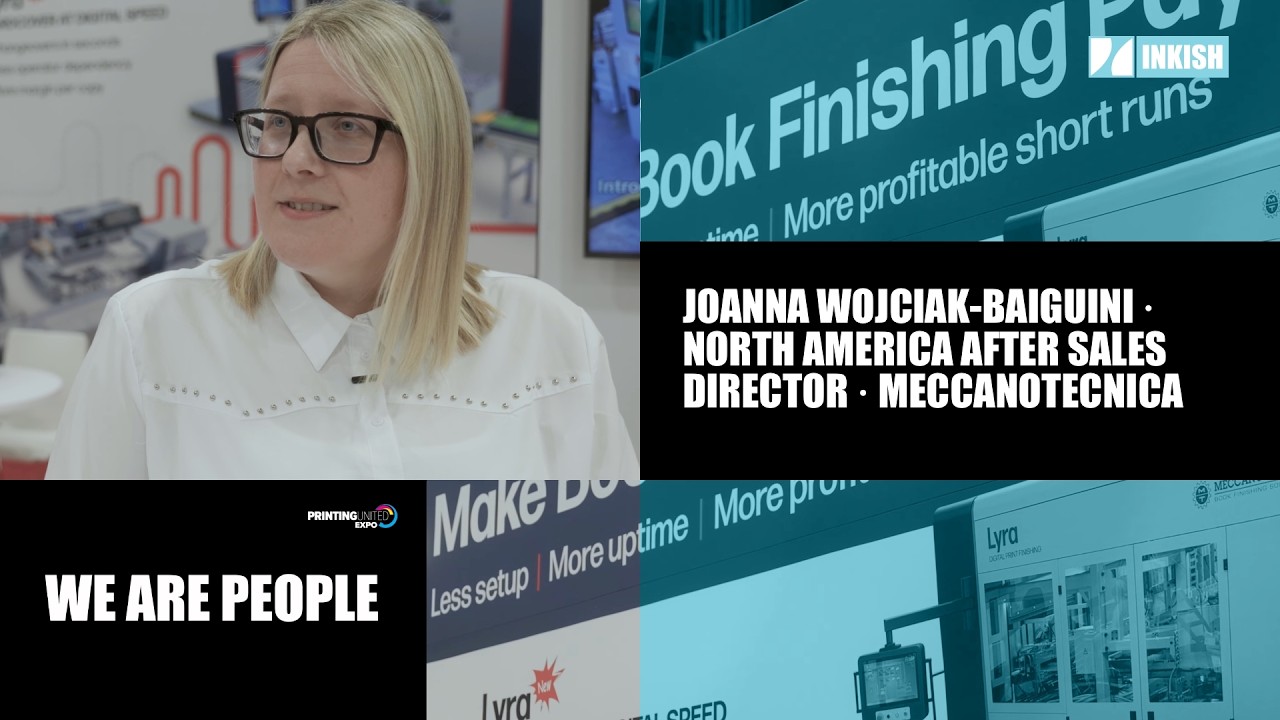
Joanna Wojciak-Baiguini · North America After Sales Director · Book Automation/Meccanotecnica
Automation doesn’t only change production. It also changes the people who have to support the machines.
At PRINTING United 2026 in Las Vegas, Morten B. Reitoft continues his visit with Meccanotecnica — or, as the company is known in the North American market, Book Automation — for a conversation about something that rarely gets the same attention as a new machine: service.
And that service organization is changing.
As Meccanotecnica has expanded from its traditional strength in book sewing into increasingly automated finishing solutions such as perfect binding and LYRA casing-in, the technical knowledge required to support customers has evolved as well.
Where service calls historically might have focused heavily on mechanics, today’s questions increasingly involve automation, electronics, software and communication between different systems.
That changes the role of the service engineer.
Remote connectivity has become an important first step. Rather than trying to understand a production problem from an email or telephone description, Book Automation technicians can connect directly to supported equipment, see what is happening and begin diagnosing a problem in real time.
But remote service isn’t intended to replace the technician.
Morten asks whether video calls and remote connections can sometimes become a convenient substitute for having a strong local service organization. The answer is clear: remote diagnostics are another tool for qualified service engineers. The same people troubleshooting remotely are the technicians who will travel to the customer when the problem cannot be resolved from a distance.
And plenty of situations still require someone standing beside the machine.
The discussion also turns to another increasingly important challenge: making sophisticated equipment easier to operate.
Meccanotecnica deliberately uses symbols and numerical information extensively in its user interfaces rather than relying on large amounts of written text. That makes operation more intuitive, reduces language barriers and allows similar functions to be represented consistently across different machines.
It is another example of how knowledge is increasingly being embedded into the equipment itself.
As automation increases, the machine needs to guide the operator through more of the production process. That becomes particularly important as printing and binding companies struggle to recruit highly experienced operators and increasingly need equipment that can be operated by people with less specialized knowledge.
But service isn’t only about fixing machines after they have been installed.
Customer support also creates one of the most valuable feedback channels into research and development. Service engineers see how equipment performs in real production environments every day. They hear what operators struggle with, discover unusual applications and identify where seemingly small changes could make the machines easier or more reliable to use.
That information goes directly back to the people developing the next generation of equipment.
And in this case, that connection is particularly close, with experience from years working directly with Meccanotecnica’s R&D organization now moving into the North American Book Automation service team.
As Meccanotecnica expands its product portfolio, Book Automation’s service organization therefore has to evolve with it.
More automation means more software. More connectivity means better remote diagnostics. Easier user interfaces reduce dependency on specialist operators. And stronger communication between customers, service technicians and R&D ultimately creates better machines.
The future of book production may be increasingly automated.
But somebody still has to understand how everything works.
Watch Morten B. Reitoft’s conversation from the Book Automation / Meccanotecnica booth at PRINTING United 2026 in Las Vegas.



No Data Found.
Content for this section will appear here once available
Thu September 24th
Enrico Barboglio · Group CEO · Stratego Gr...
Italy has a long and important history in printing and converting technology, but technology alone isn't enough to build an international market. You also need connections. At PRINTING United 2026 in Las Vegas, Pat McGrew meets longtime industry friend Enrico Barboglio at the Italian Trade Agency pavilion to talk about why Italian companies are exhibiting in the United States — and why an international trade show is about considerably more than selling machines. The Italian Trade Agency, together with the Italian printing and converting industry, has brought a group of companies to Las Vegas representing different parts of the production ecosystem. There are machinery manufacturers, software developers, color and process-control specialists, personalization technology and companies providing knowledge and communication to the graphic arts industry. It is only a small representation of the Italian printing industry. Many more Italian manufacturers are exhibiting elsewhere at PRINTING United through American subsidiaries, distributors and partners, illustrating just how significant Italian technology has become across printing, packaging, converting and finishing. For Enrico, however, the most important reason for being in Las Vegas can be summed up in one word: connection. Companies come to PRINTING United to meet customers and potential partners, of course, but they also come to learn. They meet other manufacturers, discover technologies, understand how markets are developing and create relationships that can ultimately lead to entirely new business opportunities. And those relationships work in both directions. Italian companies can introduce American printers and converters to technologies they may not already know, while conversations with the North American market provide Italian manufacturers with new ideas, requirements and perspectives to bring home. PRINTING United is therefore one stop on a much longer international journey. That journey leads toward Print4All in Milan in 2027. Print4All was created to bring together technologies and applications from across printing and converting rather than treating individual print segments as isolated industries. Commercial printing, digital, offset, flexo, gravure, converting, packaging, finishing and increasingly software and automation are all becoming part of a much more connected production ecosystem. That thinking is now being developed further through closer cooperation between ACIMGA and ARGI and the creation of the Printing & Converting Technology Alliance. The objective is to represent technology across the complete printing and converting value chain and create a stronger platform for manufacturers, suppliers, printers, converters, brands and international markets to meet. And perhaps that reflects the industry itself. A printing company rarely buys technology in isolation anymore. Presses need software. Software needs data. Printing requires finishing. Packaging requires converting. Automation requires communication between systems. And increasingly, the companies building those technologies need each other just as much as their customers need them. The machinery may be what visitors initially come to see. But relationships are what ultimately move an industry forward. Watch Pat McGrew's conversation with Enrico Barboglio at the Italian Trade Agency pavilion at PRINTING United 2026 in Las Vegas — and hear why international connections are such an important part of the future of Italian printing and converting technology.