


























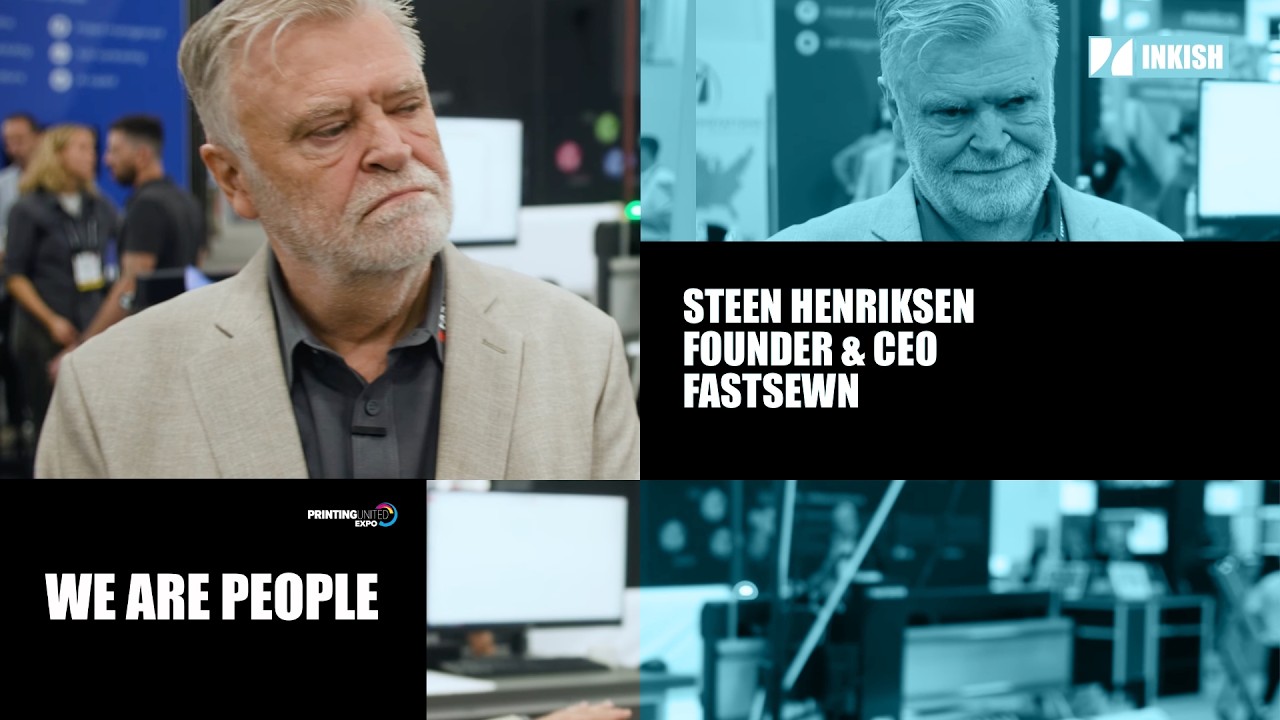
Steen Mikkelsen · Founder & CEO · Fastsewn
Printing, cutting, and workflow have become increasingly automated, but in soft signage and textile production, one important process remains surprisingly dependent on manual labor: sewing.
At PRINTING United 2026 in Las Vegas, Morten B. Reitoft meets Danish innovator Steen Mikkelsen, founder of FASTSEWN, to see how he plans to change that.
Steen is no stranger to solving problems in wide-format production. Years ago, he developed i-cut, using vision technology to compensate for distortions in printed flexible materials and enabling accurate contour cutting. What Steen initially thought might sell a few systems eventually became a technology used throughout the industry.
Now he has turned his attention to sewing.
The idea behind FASTSEWN came from a simple observation: cutting systems are highly automated, yet printed textiles are often taken from those systems and handed to skilled operators for sewing. Finding those operators is increasingly difficult, and manual handling can account for a significant portion of total production time.
Solving it wasn’t easy. Steen spent years considering how a sewing machine could move across a flat textile without requiring the material itself to be continuously manipulated by an operator. He even gave up on the idea — briefly — before the solution came to him while he was asleep on his sofa.
That idea became FASTSEWN’s patented Moving Cavity Technology.
Rather than moving the textile around a conventional sewing machine, FASTSEWN creates access underneath the material so the sewing mechanism can follow the required path while the textile remains positioned on the table. Combined with vision, CNC control and cutting technology, the system can automate applications such as silicone edge graphics, banners, pillowcase displays and other two-dimensional textile products.
The full-size FASTSEWN system being demonstrated from Denmark handles material up to 3.3 meters wide, and because production can be processed in sections, the finished product can be considerably longer than the table itself.
For Steen, however, the opportunity isn’t only about replacing manual labor. Automation can change what companies choose to produce. Just as automated contour cutting opened completely new design possibilities, automated sewing could make shapes, curves, short runs and customized textile products economical where manual sewing previously made them too expensive.
And despite having already retired once, Steen doesn’t seem ready to stop inventing.
Watch Morten B. Reitoft’s conversation with Steen Mikkelsen from FASTSEWN at PRINTING United 2026 in Las Vegas.



No Data Found.
Content for this section will appear here once available
Fri September 25th
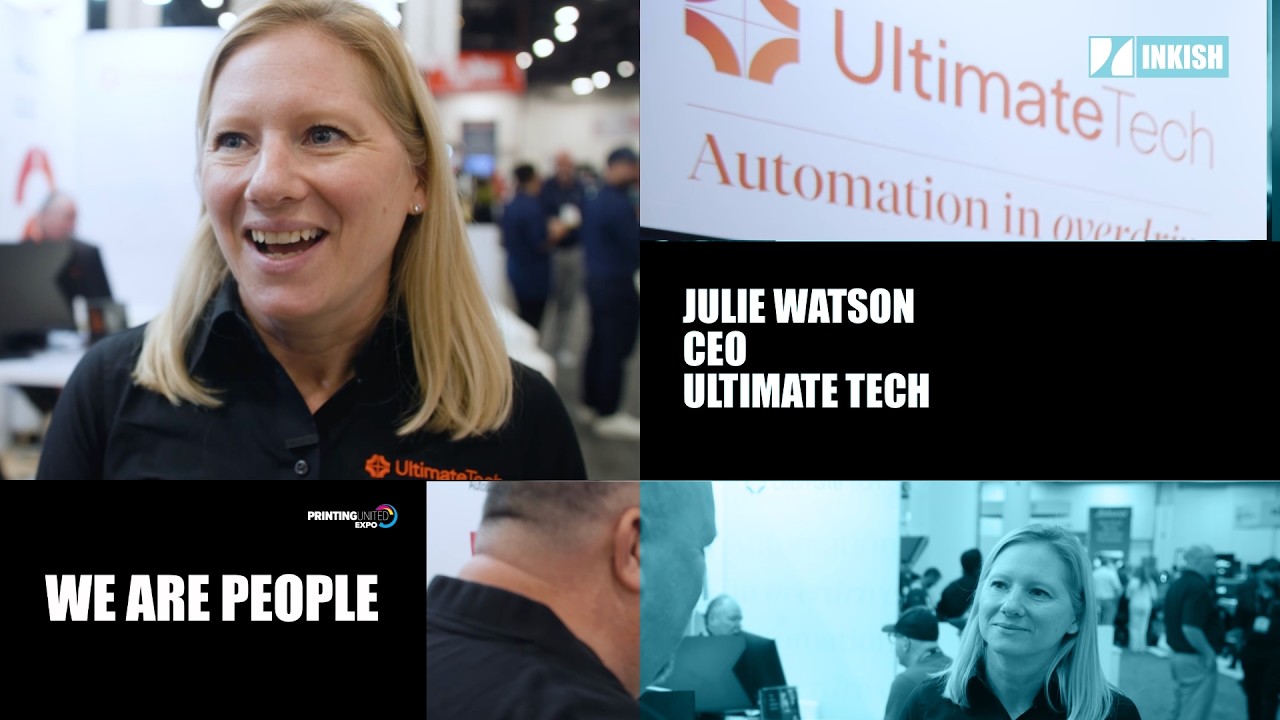
Julie Watson · CEO · Ultimate Tech
At PRINTING United 2026 in Las Vegas, Morten B. Reitoft meets longtime friend Julie Watson, CEO of Ultimate Tech, for a conversation that has very little to do with products — and everything to do with the leadership required to create them. Julie grew up around the printing industry and eventually took over the family company founded by her father. But taking over didn't mean simply continuing what already existed. Ultimate had to reinvent parts of its technology, invest in an entirely new platform and make decisions based not only on what customers needed today, but where the industry might be ten years from now. One of those decisions was moving Ultimate Impostrip toward an HTML5-based architecture. At the time, Julie remembers considerable internal discussion and pushback. But that technology decision ultimately helped create the foundation for today's multi-platform, cloud and containerized environments. And that raises an interesting leadership question: What happens when the team doesn't immediately agree with the direction? For Julie, leadership isn't about ignoring those concerns. Disagreement can reveal real problems that need to be addressed. The objective is to create enough alignment that when a decision is finally made, the team moves forward together. “You can go fast alone, but you go far together” is a philosophy she clearly believes in. Morten and Julie discuss making difficult decisions, accepting accountability, learning from other leaders, peer groups and books, and why Julie doesn't believe in simply trying to become the next Steve Jobs — or anyone else. Instead, she focuses on values. Collaboration. Innovation. Diversity. Curiosity. And creating an organization where people feel part of the direction rather than simply being told where to go. The conversation also touches on one of the differences between family-owned and financially driven companies. Short-term revenue will always matter, but Julie believes leadership also requires making decisions that may take years to deliver their full value — particularly when developing technology for an industry changing as quickly as print. Products don't simply appear on a trade-show floor. Behind every new platform, workflow or innovation are people making decisions about technology, investment, culture and the future. Watch Morten B. Reitoft's conversation with Julie Watson from Ultimate Tech at PRINTING United 2026 in Las Vegas.