



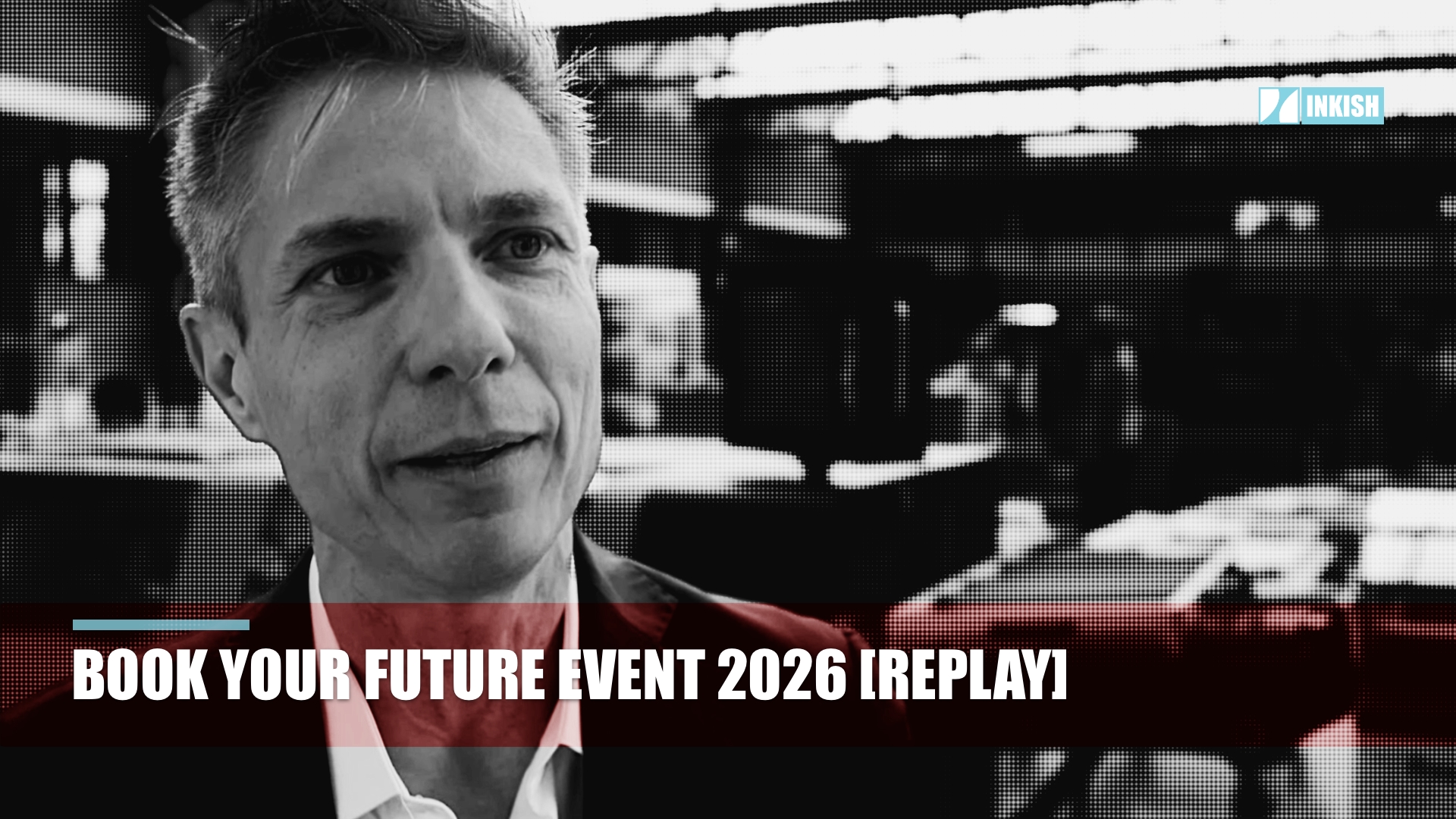














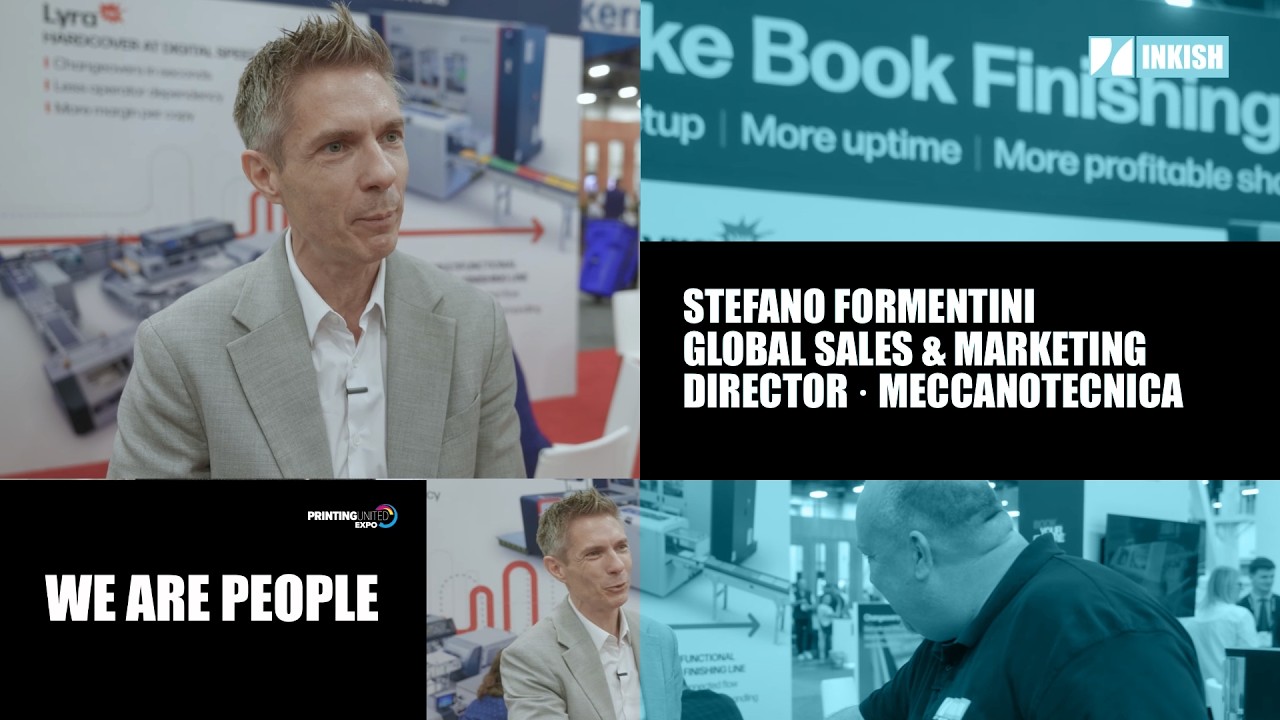
Stefano Formentini · Global Sales & Marketing Director · Meccanotecnica
The book industry is changing. Print runs are getting shorter, publishers want less inventory sitting on shelves, skilled bindery operators are becoming increasingly difficult to find, and digital printing has made book-of-one production commercially realistic.
But finishing still has to keep up.
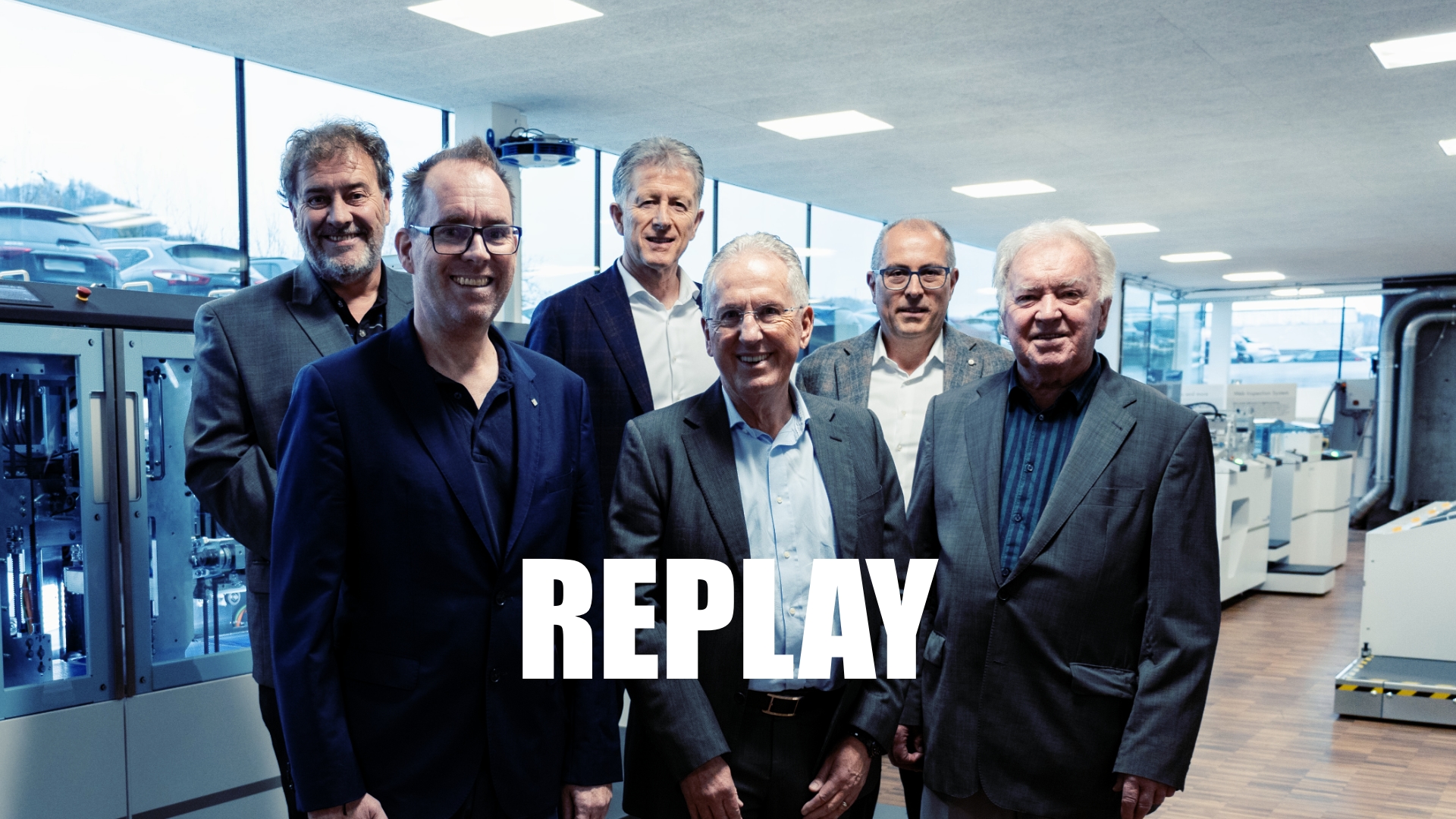
At PRINTING United 2026 in Las Vegas, Morten B. Reitoft meets Stefano Formentini from Meccanotecnica for another look at LYRA — the company’s new automated casing-in solution first presented at Book Your Future in Bergamo earlier this year.
Since the launch, interest has been significant, but Meccanotecnica isn’t rushing the first installations. Stefano explains that the company is working closely with prospective customers, studying their production data, running tests and identifying where LYRA can genuinely improve the economics of their book production.
And economics is really what LYRA is about.
For decades, hardcover finishing has depended heavily on skilled operators and equipment designed either for relatively manual production or very high industrial volumes. Meccanotecnica believes there is an important space between those two worlds — particularly as digital printing drives shorter runs, more frequent job changes and increasingly book-of-one production.
LYRA is designed specifically for that environment.
Automated changeovers take seconds rather than minutes, and much of the traditional knowledge of the experienced bookbinder has been effectively embedded in the machine. The objective is to enable an operator with considerably less specialist knowledge to produce consistent hardcover books while capturing experienced bindery expertise in the technology itself.
That becomes increasingly important in North America.
Stefano describes the U.S. and Canadian markets as among the world’s most developed for digital book production. At the same time, printers are facing the same pressures seen throughout the industry: difficulty finding skilled employees, increasing labor costs and the need to reduce manual touchpoints.
Publishers are changing as well.
Rather than financing large inventories of books that may remain in warehouses for months or years, publishers increasingly want production to follow actual demand. Digital printing makes that possible on the press side, but finishing must be equally capable of economically producing one copy, ten copies, several hundred — or even runs of one or two thousand books.
That is the space Meccanotecnica wants LYRA to address.
The conversation also turns to something affecting almost every investment discussion in the United States right now: uncertainty.
Geopolitical developments and tariffs are influencing purchasing decisions, and some companies are choosing to delay investments while waiting for greater clarity. Stefano understands the hesitation but also sees a risk in waiting too long.
Technology continues to improve regardless of the political environment.
A modern automated production line can deliver significant productivity improvements compared with equipment installed 15 or 20 years ago. Reduced labor requirements, faster changeovers, lower waste and increased throughput can potentially outweigh other cost increases associated with an investment.
Companies therefore face an interesting decision.
Wait for certainty that may never arrive — or invest in productivity and competitiveness that they can actually control.
For Meccanotecnica, that investment philosophy fits directly into its broader evolution. Historically famous for book sewing, the company has steadily expanded into perfect binding, digital finishing and now automated casing-in, creating an increasingly complete production environment for digitally manufactured books.
The press has already become digital.
Now Meccanotecnica wants to industrialize what happens after it.
Watch Morten B. Reitoft’s conversation with Stefano Formentini from Meccanotecnica at PRINTING United 2026 in Las Vegas.



No Data Found.
Content for this section will appear here once available
Wed September 30th
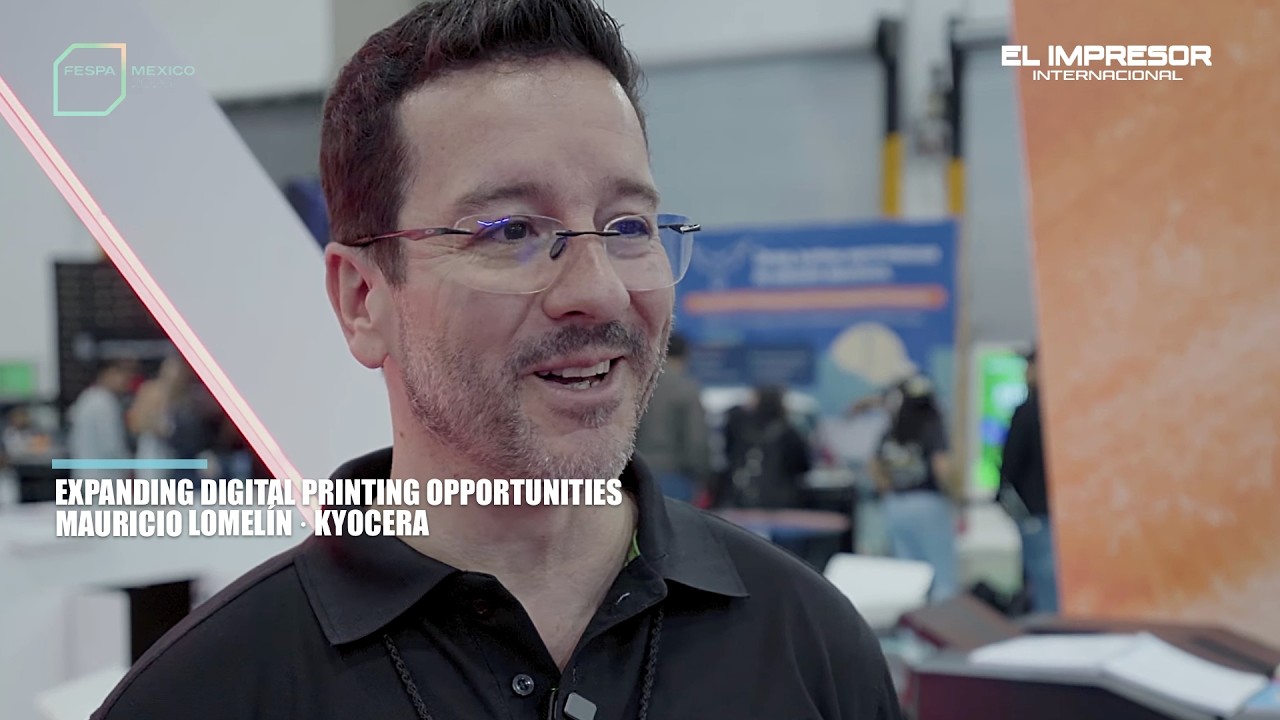
Mauricio Lomelín · Kyocera | Expanding Digi...
English description below: Desde FESPA México 2026, Claudia Mendoza conversa con Mauricio Lomelín, de Kyocera, sobre la evolución de la impresión digital, las nuevas oportunidades para la industria gráfica y la estrategia de la compañía para ampliar su presencia en el mercado de impresión de producción. Mauricio presenta la TASKalfa Pro 15000c, conocida como Victoria, un equipo de inyección de tinta con tecnología propia de Kyocera, capaz de producir hasta 150 páginas por minuto y alcanzar volúmenes de un millón de páginas mensuales. Con aproximadamente 30 equipos instalados en México y 1.000 a nivel mundial, según Mauricio, la compañía continúa consolidando su presencia en aplicaciones como la producción de libros, los documentos transaccionales y la impresión de grandes volúmenes. La conversación también presenta Nova, la nueva propuesta de equipos de producción láser de Kyocera, diseñada para complementar la tecnología inkjet. Mauricio explica cómo la combinación de ambas tecnologías permite a los impresores desarrollar procesos de producción más flexibles, reducir costos operativos y avanzar hacia la impresión bajo demanda. La sustentabilidad, la eficiencia energética, la integración de software y la transición de la impresión tradicional a la digital completan una entrevista que muestra las oportunidades que Kyocera identifica para el futuro de las artes gráficas. --- At FESPA Mexico 2026, Claudia Mendoza speaks with Mauricio Lomelín from Kyocera about the company's expanding presence in production printing and the growing opportunities for print service providers transitioning from conventional to digital technologies. Mauricio introduces the TASKalfa Pro 15000c, nicknamed Victoria, a high-volume inkjet press powered by Kyocera's proprietary printhead technology. Capable of producing up to 150 pages per minute and handling monthly volumes of up to one million pages, the system targets applications ranging from book production to transactional documents. According to Mauricio, Kyocera has approximately 30 installations in Mexico and recently reached 1,000 installations worldwide. The interview also explores Nova, Kyocera's new production toner systems, which complement its inkjet technology and enable printers to combine different production methods. Mauricio discusses how these solutions support the transition toward digital and on-demand printing while emphasizing low operating costs, productivity, and workflow integration. Sustainability, energy efficiency, variable data printing, and Kyocera's broader ambitions in the graphic arts industry are central themes in a conversation about the changing requirements of modern print production.