All videos

Select the movie you want to view

Wed July 19th

En

ChatGPT and Ultimate TechnoGraphics Dave...

Boone Graphics is located in Santa Barbara, about 2 hours drive from Los Angeles, and besides the traffic in LA, the rest of the tour was super nice. When we got to Boone Graphics, we were kindly received and got into a super nice meeting room with all types of print - and the rest of the day was interesting. Learning about how ChatGPT is used to write XML documents to be used with Ultimate TechnoGraphics Impostrip and Bindery was a surprise - but the story and how Boone Graphics navigates in the industry was just super nice. Enjoy! LinkedIn Profile: https://www.linkedin.com/in/dave-tanner-313ba58/ Apology from the editor: As Boone Graphics ALSO uses both Impostrip and Bindery from Ultimate TechnoGraphics, Editor Morten B. Reitoft asked about the use of Impostrip Bindery but used the phrase ImpoBind, which obviously isn't the name - sorry for this - hereby disclaimed!

Mon November 18th

En

Charlotte Tueckmantel EFI Workflow Summi...

The many opportunities with Marketing Automation and Web to Print for going forward and why! Link to presentation: https://grafkom.s3.eu-central-1.amazonaws.com/WS19/EFI_eCommerce+Trends_charlotte_low.pdf

Fri June 5th

En

Charles Jarrold · CEO BPIF Print Matters...

At Intergraf Print Matters in Budapest, Morten Reitoft speaks with Charles Jarrold, Chief Executive Officer of the BPIF (British Printing Industries Federation), following a panel discussion focused on sustainability, COâ‚‚ reduction, and the practical realities facing the printing industry. While environmental responsibility remains a key topic across the industry, Charles explains why sustainability must be approached through the lens of business reality. Drawing on insights from a panel that included representatives from commercial printing, book manufacturing, and the ink supply chain, the discussion highlights the balance between environmental ambitions, economic viability, and customer expectations. The conversation explores how sustainability initiatives have evolved over the past decade. While legislation and regulatory requirements continue to drive change, Charles points out that customer demand and a genuine commitment from businesses to "do the right thing" are increasingly important motivations. For many companies, sustainability is no longer simply a compliance exercise but an integral part of how they operate and compete. Morten and Charles also discuss the complexities of packaging, books, and print-on-demand production. While reducing waste remains a common goal, the conversation highlights the importance of understanding the broader environmental picture. Packaging, for example, often plays a critical role in reducing food waste, while advances in just-in-time book production have helped reduce the number of unsold books that were historically pulped. The interview touches on the challenges of sustainability legislation, recycling requirements, de-inking, digital printing technologies, and the role of manufacturers in supporting industry-wide environmental goals. Charles argues that meaningful progress requires collaboration across the entire value chain, from suppliers and manufacturers to printers and customers. The discussion concludes with reflections on Brexit, European legislation, and the continuing importance of collaboration between the BPIF and Intergraf. Despite the UK's departure from the European Union, Charles explains why close cooperation with European industry organizations remains essential, particularly in helping members understand and adapt to legislation that continues to influence cross-border trade and business operations. A thoughtful conversation about sustainability, environmental responsibility, packaging, legislation, and the practical challenges of balancing commercial success with long-term environmental goals.

Thu September 24th

En

Charles Bourg · CEO · C.P. Bourg

At PRINTING United 2026 in Las Vegas, Wayne Beckett finally catches up with Charles Bourg from C.P. Bourg — although finding him isn't easy. C.P. Bourg technology is running not only on the company's own booth, but alongside several of the industry's leading digital print manufacturers. And that is very much the point. C.P. Bourg's philosophy is to remain print-engine independent and give customers the flexibility to choose the printing technology that fits their business while connecting it to highly automated finishing. Charles explains the company's Dual Mode concept, where the same finishing line can operate directly inline with a digital press or independently using a sheet feeder. Customers can decide job by job whether inline or offline production makes the most sense — without investing in completely separate finishing systems. Making that happen isn't as simple as connecting two machines. Inline finishing has to handle sheets arriving directly from the press, potentially with heat, curl and other characteristics that wouldn't normally be present in an offline stack. For C.P. Bourg, developing reliable inline solutions therefore also improves the engineering and paper handling of its offline systems. At PRINTING United, C.P. Bourg is demonstrating its technology together with partners including Canon and Xerox, while continuing to develop relationships with other press manufacturers. Charles describes the company almost as the “Switzerland” of finishing: C.P. Bourg doesn't want to tell customers which printing technology to buy — it wants to provide the finishing platform behind whichever technology they choose. Wayne and Charles also look at C.P. Bourg's latest highly automated booklet-making technology. The system can move between very thin and significantly thicker booklets automatically, reducing operator intervention and making highly variable production increasingly practical. That flexibility reflects where digital printing is heading. Shorter runs, more job changes and increasing automation require finishing equipment that can adapt just as quickly as the press itself. Whether production is inline, offline or somewhere between the two, the objective remains the same: fewer touchpoints, reliable production and more finished work out of the factory. Watch Wayne Beckett's conversation with Charles Bourg from C.P. Bourg at PRINTING United 2026 in Las Vegas.

Mon April 26th

De En Es Fr Nl Pt

Changing Trends Moving to Mid-Web for In...

The packaging market continues to surprise new innovative solutions, new capabilities, and a changing trend towards a wider format. FlexoPrint in Randers, Denmark, is one of Denmark's leading flexo printing companies, serving customers in Scandinavia, Germany, and as CEO Lars Ole Nauta says, "Wherever there is an order, we try to get it." In this film, we get an insight into the recent investment of the Nilpeter FA 26" machine, which, according to Nauta, serves a gap in the market. FlexoPrints flexibility to serve fast is a KPI that will help to fill the machine with more jobs. Enjoy the film.

Fri October 24th

En

Chad Ferguson · VP Sales · MBO America ·...

At Printing United in Orlando, Morten B. Reitoft from INKISH speaks with Chad Ferguson, Vice President of Sales at MBO America, about his first year in the role and the company’s expanding footprint in the finishing market. After nine years with Standard Finishing, Chad Ferguson joined MBO America to take on a leadership position focused on driving sales growth, building stronger customer relationships, and broadening awareness of MBO’s digital finishing solutions. He explains that the biggest change for him personally has been moving from working independently as a territory manager to leading a national sales team, emphasizing collaboration and mentorship across the organization. Ferguson highlights that while MBO has long been recognized as a global leader in folding equipment, the company has successfully evolved into a major player in roll-fed digital finishing. At the show, MBO America is demonstrating its roll-fed digital line featuring an auto splicer and the CC23 contour cutter—technologies that showcase the company’s strength in inline production and modular design. Each component is built for flexibility and efficiency, allowing customers to reconfigure their systems as needed. The modular “parking lot method,” as Ferguson describes it, means users can roll components in and out on caster wheels, adapting their setup for specific production jobs with ease. He emphasizes that many printers still associate MBO primarily with traditional sheetfed folding, yet the company’s modern portfolio includes advanced solutions for high-volume, data-driven applications such as direct mail, transactional printing, and commercial finishing. The hallmark of MBO equipment remains its robustness, precision, and German engineering quality. Ferguson’s goal is to ensure more printers in North America recognize that MBO can support nearly any finishing need, from simple folding to complex inline digital workflows. Discussing automation, Ferguson notes that while Europe has led in adopting collaborative robots and autonomous systems, the U.S. market is now catching up. He mentions strong customer interest in MBO’s CoBo-Stack and other automation solutions, particularly as print providers struggle with labor shortages. For many shops, he says, the challenge of finding and retaining skilled operators is driving investment in automation. Ferguson believes this shift is inevitable and that MBO’s adaptable, modular approach positions it perfectly to help printers boost productivity, reduce manual handling, and future-proof their operations.

Sat May 9th

Es

Cesar Hernandez Director Comercial Fine ...

At Expográfica in Guadalajara, César Hernández, Commercial Director of Fine Arts México, speaks about the company’s 26-year journey serving the Mexican print industry with inks, blankets, chemicals, and consumables for offset production. The conversation explores Fine Arts México’s international partnerships, growing interest in flexographic printing, and the company’s increasing focus on sustainability, including products such as compostable-substrate-compatible inks. César Hernández also shares his positive impressions of the exhibition and explains why demand for environmentally conscious solutions continues to grow across the Mexican print market.

Wed September 16th

En

CERM O2 — Building the MIS for What Come...

A year after Omikai became part of CERM, Mathias is back in front of the INKISH camera — but this time with something entirely new to show. At Labelexpo Americas in Chicago, CERM introduces O2 for the first time. It is a new browser-based MIS platform combining the technology and thinking developed at Omikai with CERM's four decades of industry experience and extensive customer base. The first phase is aimed at label converters, initially targeting companies with around 10–20 employees. But the ambition is considerably bigger. O2 has been built API-first. Everything that can be done through the user interface can also be accessed through APIs — and through MCP, allowing users and developers to interact with the system from LLMs, build their own integrations, develop alternative interfaces, and potentially automate processes in entirely new ways. For Mathias, that architecture reflects a fundamental change in how MIS systems will be used. Rather than seeing the MIS simply as an application employees log into, CERM sees O2 increasingly as an engine behind other applications, integrations, AI tools, and workflows. The user interface itself has also been designed around simplicity. Customer service employees increasingly need to work quickly, often without years of specialist print knowledge, making ease of use just as important as what happens behind the scenes. And O2 won't stop with labels. The roadmap includes flexible packaging, folding cartons, multi-site organizations, and increasingly complex production environments. For Mathias, the acquisition has also created a very different working life. As CEO and owner of Omikai, product development was only one of many responsibilities. Inside CERM, his assignment has become wonderfully simple — although perhaps not easy: Build the best product possible. O2 is being shown publicly for the first time in Chicago, with selected customers expected to begin using the platform in early 2027. In this INKISH film, Morten B. Reitoft talks with Mathias about the journey from Omikai to CERM, API-first development, AI and MCP, simplicity in MIS, and why O2 may represent much more than simply another new management information system.

Wed September 16th

En

CERM O2 — Building the Future Before You...

CERM already has a successful enterprise MIS in CERM 7. So why invest heavily in building an entirely new platform at the same time? For Jan, the answer is simple: because standing still isn't an option. At Labelexpo Americas in Chicago, CERM is publicly showcasing O2 for the first time — a cloud-native, multi-tenant MIS platform developed alongside CERM 7 and designed to become an increasingly important part of the company's long-term future. Initially, O2 will focus on smaller label converters — typically businesses with perhaps 10–15 employees, one or two presses, a handful of finishing devices, and relatively straightforward production requirements. But that is only the starting point. CERM's ambition is ultimately to develop O2 into an enterprise-level MIS capable of supporting increasingly complex label, packaging, and multi-site environments. And the architecture matters. Rather than simply hosting traditional client-server software in the cloud, O2 has been designed as a genuinely cloud-native, multi-tenant platform. For customers, that potentially means faster deployment, easier maintenance, improved scalability, and less dependence on local servers and IT infrastructure. Of course, building a new MIS while continuing to develop an established flagship product requires considerable investment — and perhaps a little courage. CERM is very clear that existing CERM 7 customers won't be forced to migrate. Development of CERM 7 continues, and as O2 evolves, CERM plans to create migration tools that can eventually provide a smoother path between the platforms when — and if — customers decide the time is right. For Jan, this is about thinking long term. Not next year. But 10, 15, and 20 years ahead. In this INKISH film, Morten B. Reitoft talks with Jan about why CERM decided to build O2, the difference between hosted and truly cloud-native software, where O2 fits alongside CERM 7, and why sometimes the biggest risk for a successful software company is doing nothing. And yes — we still think O2 is a freaking good name.

Tue August 25th

En En

CERM Enables Better Data which helps wit...

At Blue Label Packaging, technology is important—but people, partnerships, and the ability to use data intelligently are what really make the difference. In this film, Morten B. Reitoft talks to Gareth Boyd, Director of Finance at Blue Label Packaging, about how the company uses technology, data, and strong partnerships to continuously improve its business. Blue Label has grown from its roots in craft beer labels into a much broader label business serving breweries, wineries, spirits, specialty foods, and brands found on shelves across the US. Along the way, the company has built an impressive technology platform that combines HP digital printing, ABG finishing, and CERM, with CERM serving as the software backbone connecting production, administration, customer data, and increasingly sophisticated reporting. For Gareth Boyd, the financial perspective goes far beyond traditional accounting. Live shop-floor information, consumptions, clockings, sales figures, production data, and customer information flow through CERM and into Power BI, giving him and the management team an almost immediate view of what is happening throughout the business. That visibility also changes process improvement. Instead of implementing a change and waiting months to determine whether it worked, Blue Label can see the impact in the numbers almost immediately. Different departments can build reporting around exactly the information they need—from marketing and sales to production, operations, and finance. But the story is also about something less measurable: partnership. Gareth describes CERM as a company willing to listen, customize, connect old and new technology, and develop solutions when a customer requirement doesn’t fit neatly into an existing box. Over the years, CERM has evolved from essentially being the system where orders were placed into something Blue Label simply cannot imagine operating without. And perhaps that philosophy reflects Blue Label itself. Quality and delivery are expected. What differentiates a company is how it responds when something doesn’t go exactly as planned—whether someone answers the phone, solves the problem, and continues investing in the relationship. Technology, live data, process improvement, culture, and people all come together in this conversation with Gareth Boyd—a fascinating insight into how Blue Label Packaging continues to develop its business with a long-term perspective.


Mon August 17th

En

CERM changed the agenda and delivered Gr...

What started in 1938 as a small brokerage serving the confectionery industry has evolved into Revere Group, a 63-person packaging company with capabilities in printing, laminating, converting, and cold-seal. Still family-owned, Revere Group today serves confectioners and premium food producers across the US with both stock packaging and highly customized solutions. In this film, Co-President Mark Revere shares the story of Revere Group and explains how implementing CERM has become an important part of the company's development. Moving from an advanced Excel-based system to an integrated MIS has connected estimating, orders, production, invoicing, and accounting while providing significantly more insight into how individual jobs actually perform. That data makes a difference. Jobs that are underperforming can be identified and adjusted, while efficiencies can also be passed back to customers through more competitive pricing. Most importantly, automation has supported substantial growth without requiring the company to add employees at the same pace. For a business where employees, customers, and suppliers are regarded as long-term partners rather than disposable resources, technology is seen as a tool for growth rather than simply a way to reduce headcount. With future plans that may involve multiple sites and digital production, CERM has become much more than an administrative system. It is part of the infrastructure supporting Revere Group's next chapter. Watch the film and meet Co-President Mark Revere and a family business where relationships, manufacturing, data, and technology have evolved together for almost 90 years.

Mon November 18th

En

CEO Dietrich von Segger callas software ...

Self driving PDF – The Future of Workflow Automation by CEO Dietrich von Segger. Link to presentation: https://grafkom.s3.eu-central-1.amazonaws.com/WS19/Self+driving+PDF+S.pdf

Fri May 8th

Es

Celso Hirata Gerente de Desarrollo de Ve...

At Expográfica in Guadalajara, Celso Hirata, Sales Manager for Latin America at EFI, speaks about the introduction of the EFI M3H hybrid printer to the Mexican market together with Gaia BTL. The conversation explores the machine’s ability to print both rigid and flexible substrates, its new Kyocera printheads, high production speeds, and accessible pricing compared to competing technologies. Celso Hirata also shares EFI’s strong commitment to the Latin American market and explains why Mexico plays a key strategic role for EFI’s expansion across the region.

Tue July 4th

En

Céline Dumas Komori-Chambon IST UV-Days...

Céline Dumas is relatively new with Komori-Chambon, and maybe you don't know the company - but here you get an insight that guides you to what they are. Komori-Chambon is part of the Japanese Komori group but operates entirely independently at two locations in France. They develop packaging equipment within the offset, flexo, and rotogravure segments, but they offer end-to-end solutions developed entirely by the company. Komori-Chambon delivers mainly high-volume production, and asking Céline Dumas about product types, the answer is instant - 'think milk' with a lower voice and 'tobacco.' But listen for yourself, and I am sure if you need to know more, Céline Dumas is ready to connect with you via LinkedIn - see the link below!

Fri June 26th

En

Cees Bolijn AI, Data, Innovation · Probo...

At Durst's Print Next event in Brixen, Wayne Beckett speaks with Cees Bolijn from Probo, one of Europe's most forward-thinking print service providers, about automation, robotics, AI, and why the future of print production is being built one step at a time. Having spent the previous days attending Durst's software sessions, Cees shares his perspective on Kyveris and how it aligns with Probo's own automation strategy. While Probo is developing many of its own systems, he sees significant opportunities to combine Durst's vision with the company's existing infrastructure. For Probo, the objective is not simply workflow automation—it is the intelligent utilization of machines, materials, and people across the entire production environment. One of the most fascinating parts of the discussion focuses on robotics. Rather than placing robots directly on individual production devices, Probo is taking a broader logistics approach, using automation to move materials efficiently between machines and to create flexible production lines capable of handling different products and workflows. It is a strategy designed to maximize overall efficiency rather than optimize individual machines. The conversation also addresses one of the industry's biggest concerns: the impact of automation on employment. Cees believes robotics will inevitably change certain job functions, but rather than replacing experienced employees, the goal is to redeploy their skills towards higher-value activities such as predictive maintenance, process optimization, and quality control. At the same time, artificial intelligence is already helping to accelerate software development and simplify user interface creation, allowing innovation to move faster without necessarily increasing the size of development teams. Although Probo's automation journey only began around a year ago, measurable improvements are already visible. Better machine data, improved production sequencing, and greater visibility across operations are enabling the company to utilise both equipment and staff more effectively while laying the foundation for increasingly autonomous production. The interview concludes with a preview of INKISH FLOW, taking place at Probo later this year, where visitors will have the opportunity to experience many of these technologies in a real production environment and see first-hand how automation, robotics, and AI are reshaping modern print manufacturing. A highly insightful conversation about intelligent manufacturing, practical automation, and why the journey towards lights-out production is accelerating faster than many printers realise.

Wed May 8th

En

Cathy Bittner Senior Strategic Business ...

In this almost 14-minute chat between Cathy Bittner and Editor Morten B. Reitoft, you will learn about Canon (of course) and why they have chosen to use the word "PrintWorks" for something that sounds very much like Digital Transformation. A super great chat that we are SURE you will like!

Wed June 17th

En

Cathy Bittner & Tino Waegeleiner Bu...

At Canon's Power to Move event in Venlo, Morten Reitoft speaks with Cathy Bittner and Tino Waegelein from Canon EMEA about the company's vision for the future of production printing and the technologies shaping the next generation of print manufacturing. The conversation explores how Canon is helping customers navigate a rapidly changing market where automation, efficiency, sustainability, and evolving customer expectations are becoming increasingly important. As print service providers look for new ways to improve productivity and profitability, Canon continues to invest in technologies designed to bridge the gap between traditional production methods and the opportunities offered by digital transformation. Bittner and Waegelein share insights into the role of innovation within Canon's strategy and discuss why events such as Power to Move are important platforms for bringing customers, partners, and industry experts together. Beyond showcasing technology, the event serves as an opportunity to exchange ideas, challenge assumptions, and explore how the printing industry may develop in the years ahead. The discussion highlights Canon's commitment to supporting customers throughout their digital transformation journeys while providing practical solutions that address real production challenges. Enjoy the interview.

Tue May 26th

En

Carsten Bøg Grakom Learn With Us

In this ''Learn With Us' session Carsten Bøg from Grakom (The federation of Danish Printers) explains the ClimateCalc tool that enables printing companies to calculate their carbon emissions. One of the things Carsten Bøg talk about is the fact that the ClimateCalc originally was intended to help printing companies to save energy - now the platform gives you a great insight in your energy consumption and the emissions related to your products. To get ClimateCalc is easy (your local federation), and not very expensive.
Sun March 2nd

En

Carol Werle CEO Dalim Software Hunkeler ...

CEO Carol Werle explains how Dalim Software transformed into how Dalim is today. Jonathan Seybold and the Seybold conferences were instrumental to where not only Dalim is but the entire industry. Super interesting interview done by Pat McGrew.

Thu September 18th

En

Carmina Pinto General Manager Flexografi...

Jean Lloyd from Inkish speaks with Kamina Pinto from Flexographica at LabelExpo 2025 in Barcelona. Kamina explains that Flexographica is based in Guatemala and has been in business for 28 years, primarily as a flexo label printer. However, in recent years, they have also started producing small-quantity stand-up pouches and adopted digital printing about 14 years ago. The company handles a mix of large flexo orders and many small digital ones to meet the diverse needs of its customers, focusing on delivering consistent high quality at competitive prices. She says she is at LabelExpo to explore new technologies, particularly inkjet, which she sees as offering more vivid colors and potential differentiation compared to other digital systems. In Guatemala, she notes, there has not been much investment in new digital technologies, and Flexographica aims to be the first mover so others will follow. Kamina emphasizes that brands don’t usually dictate technology—they expect excellent quality—so it’s up to her team to guide them on what’s possible. She adds that while there are many solutions on display at the show, choosing the right OEM partner is critical because digital equipment requires long-term support and stability, not just a low upfront price. She concludes that she is looking for technology that can help Flexographica stand out from competitors by offering something different rather than competing solely on price.
Wed February 28th

En

Carmen Martina Instant Design Tool Fotof...

In the North West of The Netherlands, you will find an exciting company called Fotofabriek, which we covered a few months ago. Fotofabriek produces photo and personalized products, as you can hear from the name. Still, they also have a very comprehensive IT department that has developed a platform called Instant Design Tool. The tool enables customers to create print designs, and as Carmen Martina explains in this film, the software is a freemium version that allows customers to test before buying. The software output (PDF or PNG) can be printed with any printer, or you can route your work to Fotofabriek - super interesting and worth checking out!

Mon January 20th

En

Carmen Loher-Eicher & Adriano Gut ·...

SwissQprint launched their 5th generation of large-format printers in the week of January 13th, 2025 - and it was a launch with great anticipation, so we reached out to Carmen Loher-Eicher and Adriano Gut to learn whether this was 'ONLY' a new iteration or... We got to talk about technology, market and even gender equality - so enjoy! LinkedIn Profiles: Adriano Gut Carmen Loher-Eicher

Thu May 21st

De

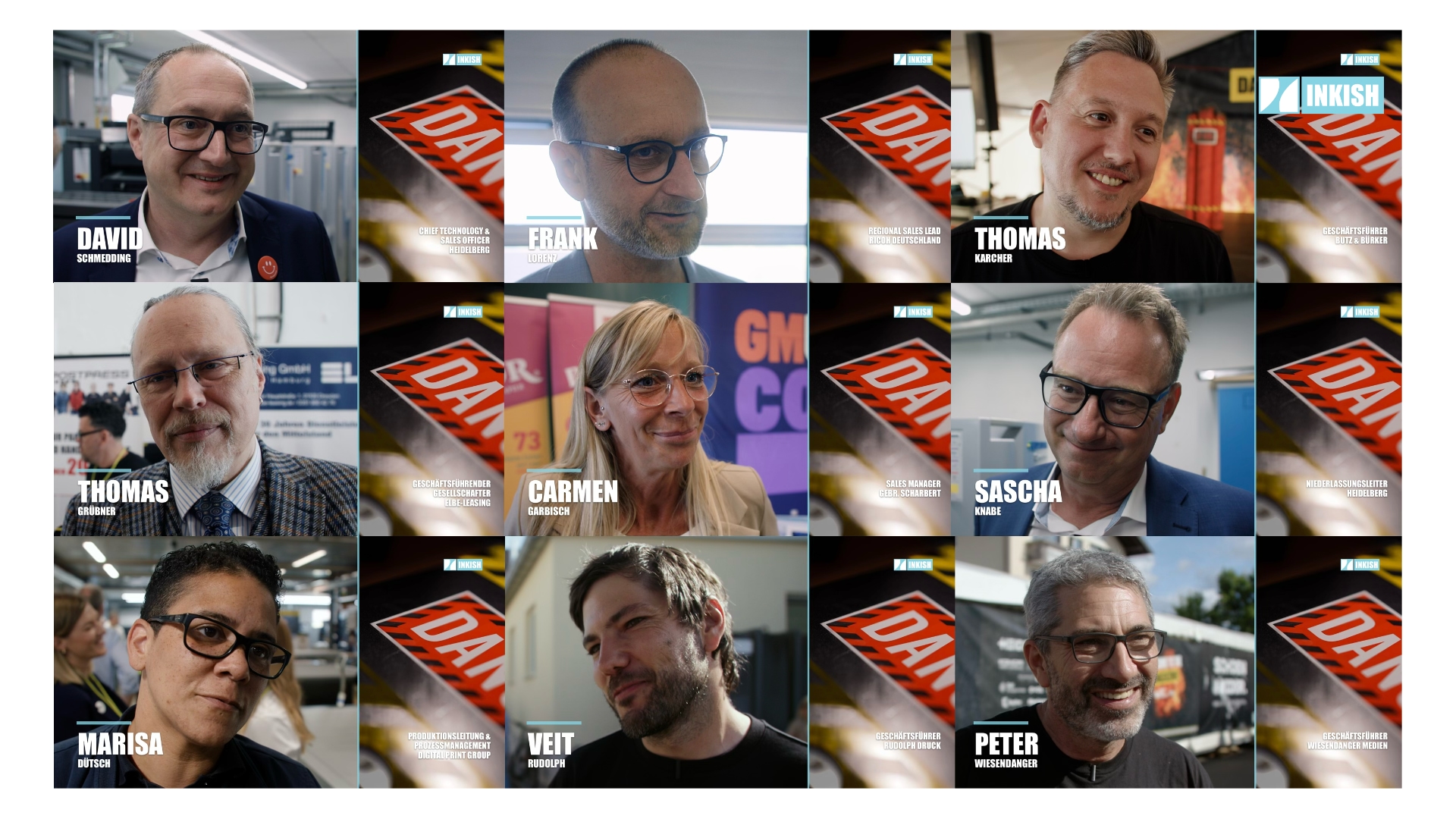
Carmen Garbisch · Sales Manager · Gebr. ...

At the Print Symposium in Murnau, Southern Germany, Morten Reitoft speaks with Carmen Garbisch from Schabert, a long-established distributor of bookbinding materials founded in 1946. The conversation focuses on the future of books, print, and the role materials play in creating premium printed products. In the “Danger Zone” discussion, Garbisch shares her concerns about a fully digital future where books could lose relevance, while also emphasizing that the book market has remained surprisingly stable. Together, they discuss the importance of the industry becoming more proactive in promoting print and publishing, not only within the industry itself, but also toward publishers, bookbinders, and consumers. Garbisch explains how events like the Print Symposium help connect suppliers, printers, and publishers, creating inspiration, collaboration, and new opportunities for the future of print.